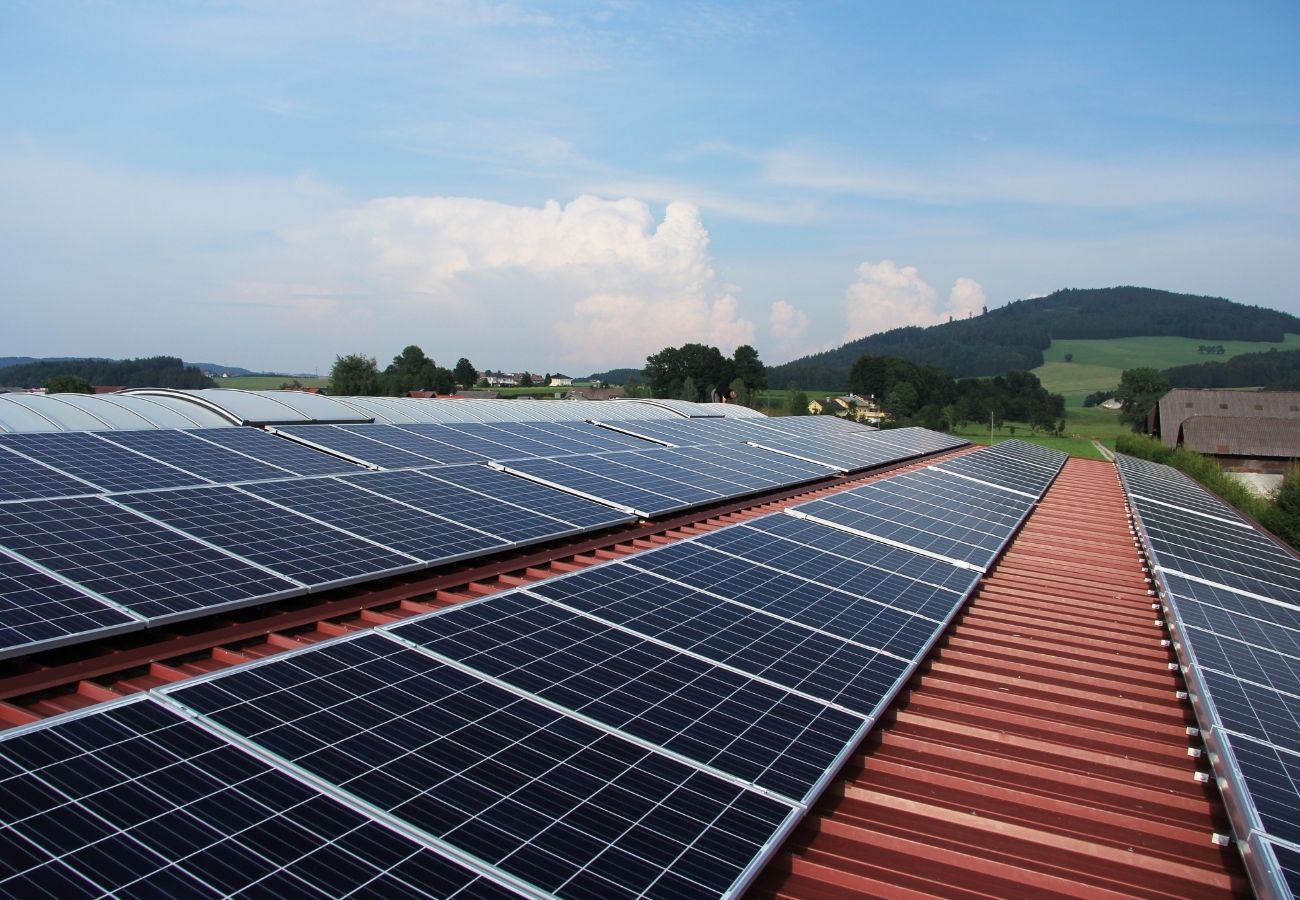
Finding fiber internet in your area starts with checking online availability maps and contacting local providers directly, but the real opportunity lies in understanding how this infrastructure can transform your community’s environmental footprint and economic resilience. High-speed fiber networks enable remote work, reduce commuting emissions, and support the digital infrastructure needed for a sustainable local economy.
The good news? Fiber deployment is accelerating across North America. In Canada alone, the CRTC’s Broadband Fund has supported nearly 6,000 kilometers of fiber infrastructure, connecting over 54,000 homes in more than 320 communities. The current priority is ensuring households have access to speeds of at least 50 Mbps download and 10 Mbps upload, though fiber networks typically deliver far more capacity.
But availability is just the beginning. When communities gain fiber access, they unlock possibilities that extend beyond faster streaming. Remote workers can build careers without relocating to distant job centers. Local businesses can compete in digital markets. Students access online education without connectivity gaps. These shifts keep income and talent circulating locally rather than draining toward urban centers.
The sustainability angle matters more than you might expect. Fiber infrastructure is exceptionally durable and energy-efficient compared to older copper networks, reducing the need for frequent equipment replacement and ongoing maintenance. More importantly, widespread fiber access makes telecommuting viable, cutting transportation emissions that would otherwise accumulate year after year.
This guide will walk you through practical steps for checking fiber availability where you live, understanding what speeds you actually need, and exploring community-level solutions if your area isn’t yet served. We’ll also look at how neighborhoods have organized to bring fiber to underserved areas, turning infrastructure gaps into opportunities for collective action.
The Sustainability Case for Fiber Internet Infrastructure
Fiber internet infrastructure connects directly to the sustainability challenges communities face today. When people can work, learn, and access services from home, they drive less. The infrastructure itself matters too: fiber networks consume less energy than older copper-based systems and last significantly longer before requiring replacement, reducing the manufacturing and disposal cycles that come with shorter-lived technologies.
The relocalize movement depends on digital infrastructure that lets communities function without constant dependence on distant cities. Fiber internet makes it possible for professionals to live in smaller towns while maintaining careers, for local businesses to reach customers beyond their immediate geography, and for communities to retain young families who might otherwise move to urban centers for work opportunities. This isn’t just about convenience. It’s about whether communities can sustain themselves economically and socially.
Consider what happens when a community gains reliable high-speed internet access:
- Remote workers reduce daily commutes, cutting transportation emissions and traffic congestion
- Local businesses access broader markets without relocating to urban areas
- Students and residents participate in education and healthcare services without traveling
- Communities become more resilient during disruptions by maintaining digital connections
- Economic activity stays local rather than draining to distant corporate centers
The CRTC has supported building nearly 6,000 kilometres of fibre across Canada, specifically targeting underserved communities. These projects aim to bring connections that meet or exceed 50 Mbps download and 10 Mbps upload speeds to households that previously had inadequate service. That technical standard matters because it represents the threshold where remote work, video conferencing, and online collaboration become genuinely practical rather than frustratingly limited.
Fiber infrastructure also shifts where economic value accumulates. When workers earn professional salaries while living in smaller communities, they spend that money locally: at neighborhood shops, with local tradespeople, at community events. That circulation of resources strengthens the local economy in ways that commuter communities sending workers to distant cities cannot match. The infrastructure becomes a foundation for community self-sufficiency rather than just a utility connection.
Understanding What Fiber Internet Really Means
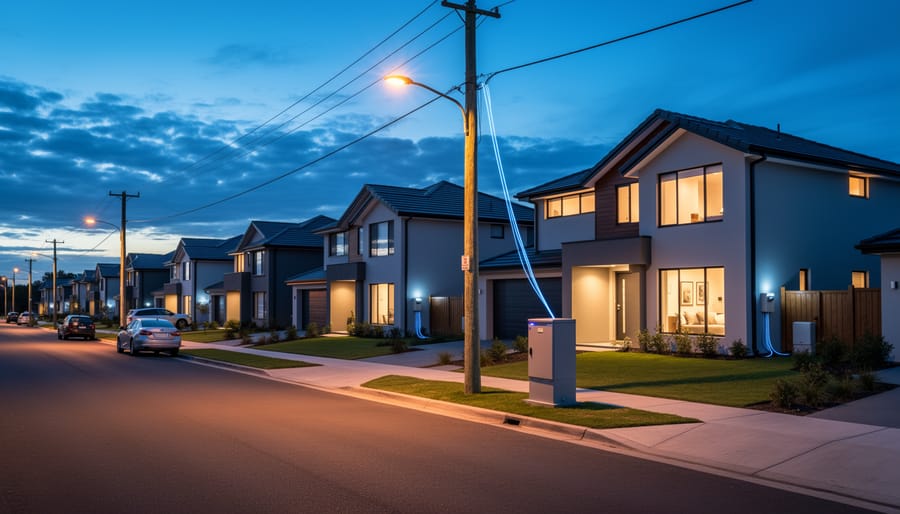
Fiber internet runs on thin strands of glass or plastic that transmit data as pulses of light. This fundamental difference in how information travels sets it apart from cable internet (which uses copper coaxial cables) or 5G home internet (which uses wireless radio signals). The light-based transmission allows fiber to carry vastly more information over longer distances without degradation, which translates to faster speeds and more reliable connections for everyone using it.
When you see internet speeds listed, they’re measured in megabits per second, or Mbps. Download speed determines how quickly you receive information from the internet, streaming videos, loading websites, or downloading files. Upload speed controls how fast you send information out, video calls, backing up files to the cloud, or posting content. The CRTC currently defines reliable high-speed internet as 50 Mbps download and 10 Mbps upload, though many fiber connections offer symmetrical speeds (the same rate in both directions) and can reach hundreds or even thousands of Mbps.
Here’s what those numbers mean in practice. A 50 Mbps connection handles basic streaming and video calls for a household. A 100 Mbps connection supports multiple people working from home simultaneously, with room for kids attending online classes and someone streaming a show. A 500 Mbps or 1,000 Mbps (1 gigabit) fiber connection means your internet basically stops being a bottleneck, large file transfers happen in seconds, multiple 4K streams run without buffering, and a houseful of devices can operate simultaneously without anyone noticing slowdowns.
When evaluating internet infrastructure for your community, look beyond the advertised maximum speed. Ask about symmetrical speeds (equal upload and download), network reliability during peak hours, and whether speeds are shared among users or dedicated to each connection. Fiber infrastructure generally offers all three advantages, it delivers the speeds advertised, maintains performance when many people are online, and provides the upload capacity that remote work and modern applications increasingly require.
How to Find Out What’s Available in Your Area
Finding out whether fiber internet is available where you live takes less time than you might expect, and the process itself can teach you a lot about your community’s connectivity infrastructure.
Start with the National Broadband Map, an interactive tool that lets Canadians explore broadband service availability across the country. This government resource shows what types of internet infrastructure exist in your area and which providers have registered service there. While coverage maps aren’t always complete, some smaller providers don’t always update their information, they give you a solid starting point for understanding what’s possible in your location.
Here’s how to approach your search systematically:
- Check the National Broadband Map to see what infrastructure types (fiber, cable, DSL) are reported in your area and which providers are listed.
- Contact providers directly, even if they don’t appear on the map, infrastructure changes faster than mapping updates, and local providers sometimes serve areas not reflected in national databases.
- Ask neighbors, local businesses, or your municipality what they’re using, word-of-mouth often reveals options that aren’t heavily advertised.
- Verify what specific technology each provider offers, since “high-speed internet” doesn’t always mean fiber, ask explicitly whether it’s fiber to the home.
- Request information about upload speeds, not just download, fiber’s symmetrical speeds matter for video calls, file sharing, and working from home.
When you talk to providers, focus on the practical details that affect daily use. Ask about installation timelines, whether there’s existing infrastructure on your street, and what it would take to bring fiber to your location if it’s not currently available. Some providers will extend fiber to new areas if enough households express interest.
Don’t assume a “no” is permanent. The CRTC has allocated approximately $769 million to projects improving access across more than 320 communities, with nearly 6,000 kilometres of fiber already built through these initiatives. If fiber isn’t available yet, your inquiry creates a data point that helps providers and policymakers understand where demand exists. Sometimes the difference between “not available” and “coming soon” is simply a critical mass of people asking the question.
Current State of Fiber Deployment and Community Access
Canada’s broadband infrastructure is undergoing a significant transformation that’s gradually reshaping what’s possible for communities across the country. The CRTC’s Broadband Fund has already allocated approximately $769 million to projects serving over 54,000 homes in more than 320 communities. This represents a meaningful shift in how government and industry are approaching internet access as essential infrastructure rather than a luxury amenity.
The physical scope of this work is substantial. Nearly 6,000 kilometres of fiber has been deployed across Canada through these funded projects, creating the backbone for improved connectivity. To put that distance in perspective, it’s enough cable to stretch from Vancouver to St. John’s and back again. This infrastructure forms the foundation for communities to access speeds that support modern internet use, including remote work, online education, and digital business operations.
The current deployment efforts target a specific threshold: 50 Mbps download and 10 Mbps upload speeds. These numbers represent what regulators consider the baseline for reliable high-speed service. For communities that have been struggling with slower connections, reaching this standard means the difference between being able to participate fully in the digital economy or being left behind.
The fund continues to accept applications for eligible projects, which means deployment is ongoing rather than complete. Underserved communities can work with potential providers to identify areas needing infrastructure improvements. While this process takes time and coordination, it represents genuine progress toward more equitable internet access across rural and remote regions that have historically been overlooked in infrastructure planning.
For communities still waiting for fiber, these initiatives offer both hope and a practical framework for advocacy. Understanding what funding exists and how deployment decisions are made helps local leaders make the case for their area’s needs.
When Fiber Isn’t Available: Building Community Solutions

Communities without fiber internet access aren’t powerless. Across the country, neighborhoods and rural areas have successfully pushed for better connectivity through collective action, demonstrating that waiting isn’t the only option when providers haven’t reached your area yet.
Start by documenting the current situation in your community. Gather data on existing internet speeds, service gaps, and the number of households affected. This information becomes powerful when presented to local government officials, regional development boards, or funding bodies reviewing broadband applications. The more specific your community can be about connectivity challenges, the stronger your case for infrastructure investment.
Connect with neighbors who share your frustration. A handful of residents requesting service rarely moves the needle, but a coordinated group representing dozens or hundreds of households changes the conversation. Create a simple online petition or survey to demonstrate community demand, and reach out to local businesses, schools, and healthcare facilities who also need reliable connectivity.
Explore community-led solutions that don’t depend on waiting for major providers:
- Form a broadband cooperative where community members pool resources to build and maintain local infrastructure
- Partner with municipalities to leverage public land and rights-of-way for fiber deployment
- Apply for funding programs that support community broadband projects, such as the CRTC’s Broadband Fund
- Investigate fixed wireless as a transitional solution while working toward fiber deployment
- Connect with regional internet service cooperatives already operating in rural areas
Some communities have successfully negotiated with regional ISPs by committing to minimum subscriber numbers or contributing to infrastructure costs. When a provider knows that a certain percentage of households will sign up immediately, the economics of deployment improve significantly.
Document your advocacy efforts and share them with neighboring communities. The shift toward remote work in the post-COVID society has made reliable internet a fundamental community asset, not a luxury. Your success story might inspire others while building momentum for broader regional improvements.
Remember that the CRTC currently accepts applications for broadband projects, and has already supported nearly 6,000 kilometers of fiber infrastructure across Canada. Your community could be part of the next funding round if you start organizing now.
Success Story: How Reliable Internet Transformed a Rural Community
When a small farming community in eastern Ontario finally gained access to reliable high-speed internet after years of advocacy, the changes rippled through every aspect of local life in ways residents hadn’t fully anticipated.
Sarah Chen had been running her graphic design business from her farmhouse for years, but spotty DSL service meant constantly declining video calls and sending files overnight. Within months of fiber installation, she hired two local assistants who could work remotely from their own homes. A retired teacher started offering online tutoring sessions to students across the region. Three families who’d been considering moves to larger cities decided to stay, able to maintain their careers while keeping their kids in the local school.
The transformation extended beyond individual work arrangements. The community’s general store began accepting online orders and offering curbside pickup, opening their customer base beyond the immediate area. A young farmer launched a subscription vegetable box service with online ordering, turning what had been weekend farmers market sales into year-round income. The local library became a hub for residents learning to navigate telehealth appointments and online government services.
Perhaps most importantly, reliable connectivity strengthened community resilience when challenges arose. During severe winter weather that made travel difficult, students could continue classes remotely, residents could access medical consultations from home, and the community Facebook group became a lifeline for coordinating wellness checks and resource sharing.
The internet infrastructure didn’t solve every challenge the community faced, but it removed a significant barrier that had been quietly draining population and opportunity for years. Residents who’d organized the initial advocacy effort now mentor other rural communities working toward similar connectivity goals, sharing the practical lessons they learned about persistence and collective action.
The question of whether fiber internet is available in your area isn’t just about faster downloads or smoother video calls. It’s about whether your community has the infrastructure foundation needed to build a more sustainable, resilient future. Access to reliable high-speed internet determines whether people can work remotely instead of commuting, whether local businesses can compete with distant corporations, whether your region can retain young families and attract new residents who care about quality of life.
When communities gain access to fiber infrastructure, they gain options. The infrastructure supports reduced transportation needs, strengthens local economies, and helps communities become less dependent on distant urban centers for economic opportunity. These aren’t abstract benefits, they’re the building blocks of self-sufficient communities that can adapt to changing environmental and economic realities.
Whether fiber is already available where you live or you’re working toward bringing it to your area, view this infrastructure as essential to your community’s long-term planning. Check the availability in your area using broadband mapping tools, ask your municipal leaders what infrastructure plans exist, and talk with your neighbors about what reliable internet access would mean for your community. If expansion is needed, explore whether advocacy, community-led initiatives, or cooperative models might work in your context.
The communities that will thrive in the coming decades are the ones investing in sustainable infrastructure now. High-speed internet access is part of that foundation, alongside clean energy, local food systems, and walkable design. Your involvement matters.