Finding fiber internet in Toronto in 2026 comes down to three steps: check whether your neighborhood is wired for fiber to the home (FTTH), compare which providers serve your address, and verify speeds and pricing before you sign. Bell dominates fiber deployment across the city with billions invested in infrastructure, offering speeds up to 6 Gbps on its pure fiber network, while Rogers covers much of the Greater Toronto Area with hybrid fiber-coax. Smaller providers like TekSavvy offer fiber in select Ontario neighborhoods, but availability remains patchy and address-specific.
Why does this matter for families and communities looking to relocate or upgrade? Reliable fiber connectivity supports remote work, cutting commute emissions and strengthening local economies when professionals can live and spend where they choose. Faster upload speeds mean smoother video calls, cloud collaboration, and the ability to participate fully in digital community initiatives. But Toronto’s fiber rollout isn’t uniform. Dense downtown cores and newer developments see faster deployment, while older residential pockets and some inner suburbs still wait for upgrades.
This guide walks you through Toronto’s fiber landscape neighborhood by neighborhood, shows you how to verify availability at your exact address, and explains what speeds and prices to expect from major providers in 2026. You’ll also learn how advocating for better local infrastructure can accelerate fiber access in underserved areas, turning connectivity into a community win that benefits everyone.
Why Fiber Internet Matters for Sustainable Living in Toronto
Fiber internet plays a surprisingly vital role in building sustainable, resilient communities across Toronto. When reliable high-speed connectivity enables remote work, it directly reduces daily commutes and the associated carbon emissions, traffic congestion, and air pollution that strain the city’s infrastructure. For families and professionals relocating within Toronto in 2026, choosing a fiber-ready neighborhood means supporting a lifestyle where working from home becomes genuinely practical, cutting transportation needs while maintaining productivity.
Beyond individual households, fiber connectivity fosters home-based businesses and local digital economies. Entrepreneurs running sustainable ventures, from online marketplaces for local food to virtual consultancy services, depend on the upload speeds and reliability that only fiber provides. This creates economic opportunities within neighborhoods rather than forcing residents to commute downtown, strengthening local self-sufficiency and keeping money circulating within communities.
The infrastructure itself contributes to sustainability. Fiber optic networks are far more energy-efficient than older copper technologies and require less frequent replacement, reducing electronic waste over time. Bell’s billions in fiber investment across Ontario are building systems designed to last decades, not years. Understanding why fiber matters goes beyond speed tests, it’s about creating the digital foundation for communities that can thrive locally, reduce their environmental footprint, and remain connected without depending on constant upgrades or wasteful equipment cycles.
Toronto Neighborhoods with Fiber Internet Access
1. Downtown Core and High-Density Condos
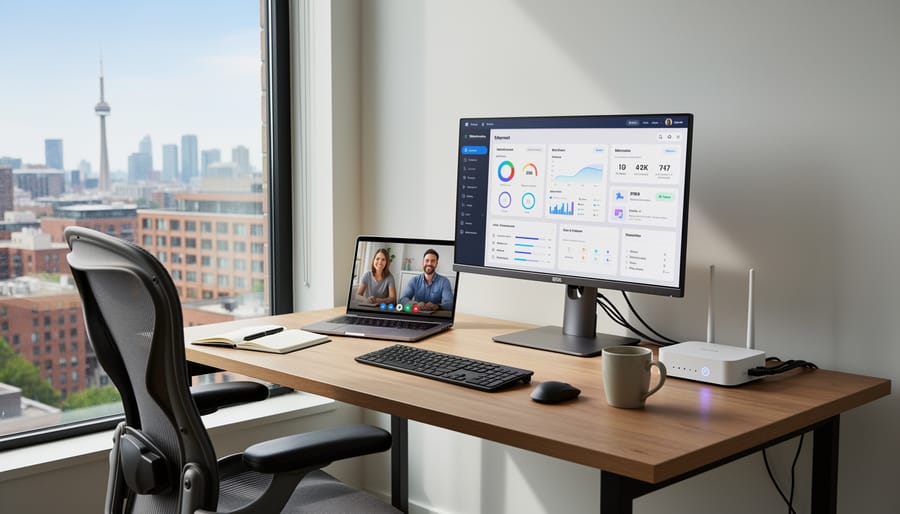
Downtown Toronto’s core and its expanding skyline of high-density condos have become priority zones for Bell and Rogers, both of whom have invested heavily in bringing fiber-to-the-home (FTTH) infrastructure to multi-unit residential buildings. Bell alone has poured billions into fiber deployment across Ontario, and this investment is most visible in the downtown neighborhoods where new construction integrates fiber cabling from the ground up. For families and remote workers relocating to Toronto in 2026, these areas offer a compelling combination: walkable urban living, reduced reliance on personal vehicles, and the high-speed connectivity needed to run a home office or support a local online business.
Newer condo developments typically include Bell or Rogers fiber as a standard amenity, meaning residents can access plans like Bell’s Pure Fibre with speeds up to 1.5 Gbps download and 940 Mbps upload for around $80 monthly. This level of performance supports video conferencing, cloud collaboration, and streaming without the bottlenecks common in older cable or DSL infrastructure. If you’re considering a move to a downtown tower, ask the building management which providers are wired in and whether the fiber runs directly to each unit. High-density living paired with reliable fiber can significantly cut your household’s transportation emissions while maintaining the connectivity that sustainable, community-centered work requires.
2. Established Residential Neighborhoods
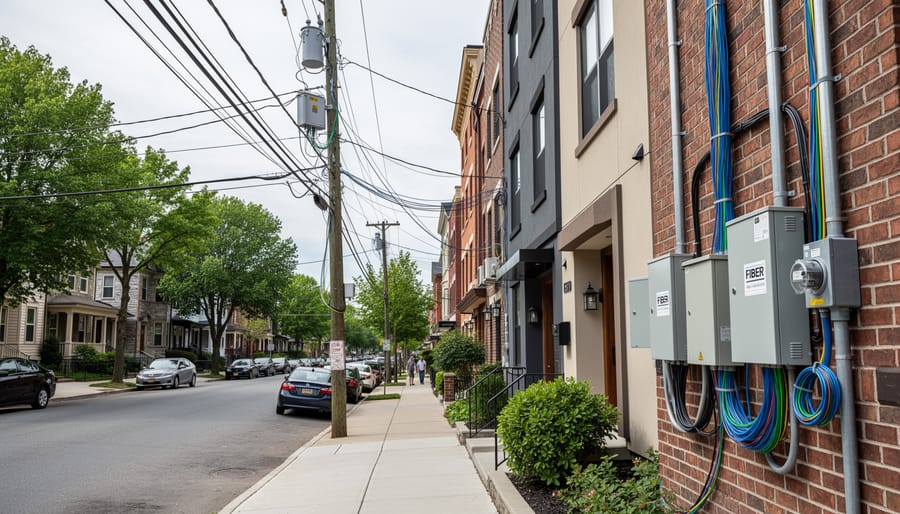
Established residential neighborhoods like The Beaches, High Park, and East York present a more complex fiber landscape. These mature communities developed long before fiber infrastructure became standard, and providers have been retrofitting access gradually over the past several years. Bell’s billion-dollar fiber investment across Ontario has reached many streets, but coverage remains inconsistent, you might find fiber on one block while the next street over still relies on older cable or DSL technology.
This patchwork availability means two homes just a few doors apart can have completely different options. Rogers has also expanded fiber in select residential pockets, but independent providers face bigger hurdles. TekSavvy, which offers fiber service across Ontario, hasn’t yet reached many Toronto neighborhoods despite operating in the province. Their network depends on wholesale access and infrastructure partnerships that don’t cover every established area.
Before you commit to a lease or purchase in these neighborhoods, verify availability at your exact address. Provider websites let you enter your postal code, but results can be misleading, a “Yes” for your postal code doesn’t guarantee your specific building or street has fiber connections. Call each provider’s customer service with your full address to confirm what’s actually available at that location. This extra step prevents the frustration of moving into a home expecting gigabit speeds only to discover you’re stuck with slower options. Many remote workers and families have learned this lesson the hard way, so do the groundwork before relocating.
3. Suburban and GTA Communities

Bell and Rogers have expanded fiber infrastructure beyond Toronto’s core into suburbs and communities across the Greater Toronto Area, making high-speed connectivity more accessible for families seeking space, affordability, and a lower-density lifestyle. Areas like Mississauga, Vaughan, Markham, and Scarborough have seen significant fiber investment as providers chase growth in these residential markets. Bell’s billions invested in Ontario fiber networks include substantial suburban rollout, while Rogers has followed with its own fiber and hybrid deployments.
For families relocating to the GTA, fiber availability opens up sustainable living options that were once incompatible with remote work. A larger home with a dedicated office, a yard for a vegetable garden, proximity to community green spaces, and lower housing costs become viable when you can maintain the same connectivity you’d have downtown. Parents working from home can eliminate hour-long commutes, reducing household carbon emissions and gaining time for local community involvement. Home-based businesses, online tutoring, and freelance work all depend on reliable upload speeds that fiber delivers.
Availability still varies by street and development age. Newer subdivisions often include fiber infrastructure from the start, while older neighborhoods may wait for provider expansion. Before committing to a suburban move, verify your exact address with Bell and Rogers directly, as coverage maps show general areas but not every home.
Fiber Internet Providers Serving Toronto in 2026
Toronto’s fiber internet landscape in 2026 is dominated by two telecommunications giants, Bell and Rogers, with newer competitors like TekSavvy working to expand their footprint. Understanding who serves where matters when relocating, because availability and service quality vary significantly by provider and neighborhood.
Bell has invested billions across Ontario to build what it markets as “100% pure fibre Internet straight to your home,” delivering true fiber-to-the-home connections. The company offers speeds ranging from entry-level packages up to 6 Gbps, making it the fastest residential option available in Toronto. Rogers operates an extensive fiber and hybrid fiber-coaxial network throughout Toronto and the Greater Toronto Area, competing directly with Bell in most neighborhoods through both pure fiber and cable infrastructure.
TekSavvy, a smaller independent provider known for competitive pricing, does offer fiber service in select Ontario locations but has not yet achieved the citywide coverage of Bell and Rogers. Many Toronto addresses receive a message that TekSavvy fiber “isn’t yet available in your neighbourhood,” meaning prospective customers must verify service at their specific address before assuming availability.
| Provider | Technology | Speeds Available | Sample Pricing | Service Area Notes |
|---|---|---|---|---|
| Bell | Pure Fiber (FTTH) | Up to 6 Gbps | $80/month for 1.5 Gbps (940 Mbps upload, unlimited) | Extensive coverage across Toronto neighborhoods |
| Rogers | Fiber and Hybrid Fiber-Coaxial | Varies by location | Competitive with Bell | Wide GTA deployment, mixed technology |
| TekSavvy | Fiber (FTTH) where available | Limited packages | Competitive pricing model | Patchy Toronto availability; check specific address |
The practical reality is that Bell and Rogers control the infrastructure in most Toronto buildings and neighborhoods, giving them first-mover advantage in new developments and established areas alike. TekSavvy’s slower rollout means it remains a viable alternative only in specific pockets where its network reaches, though its presence encourages competitive pricing from the larger players.
Practical Information for Choosing Fiber Internet
Start by checking availability at your exact address rather than assuming neighbourhood-wide coverage. Visit provider websites, Bell, Rogers, and TekSavvy all offer address lookup tools where you enter your postal code and street details to see which services reach your building. If the online checker is unclear, call customer service directly; representatives can confirm whether fibre infrastructure has been installed to your unit or if you’re on a waiting list for future expansion. Landlords and condo property managers often know whether their building has existing fibre contracts, so ask before signing a lease if reliable connectivity matters for your household.
Speed requirements vary by how you use your connection. A single remote worker handling video calls and cloud uploads typically needs 100 Mbps download and at least 20 Mbps upload, while families streaming multiple devices simultaneously may want 500 Mbps or higher. Sustainable home businesses, especially those involving large file transfers, online collaboration, or video production, benefit from symmetrical speeds where upload matches download, a hallmark of true FTTH networks. Bell’s Pure Fibre delivers up to 1.5 Gbps download and 940 Mbps upload for $80 monthly with unlimited usage, suitable for demanding households. Hybrid networks that mix fibre backbones with older cable connections to the home often deliver slower uploads, which can bottleneck remote work. If you’re weighing alternatives, understand that 5G home internet relies on wireless signals rather than physical fibre, trading potential mobility for less consistent speeds and higher latency.
Budget for upfront and recurring costs:
- Check address eligibility on provider sites using their postal code lookup tools
- Compare upload speeds for video calls, aim for at least 20 Mbps if you work from home
- Ask landlords about existing building fibre contracts before signing a lease
- Budget for installation fees, which some providers waive during promotional periods
Monthly rates start around $80 for gigabit-class fibre, but promotional pricing can reduce first-year costs. Installation fees vary; Rogers and Bell sometimes waive charges for new customers, while independent providers may charge $50 to $100 for technician visits. Factor in any equipment rental fees if you don’t purchase your own modem, and confirm whether the advertised price includes taxes and regulatory fees to avoid surprises on your first bill.
Local Tips for Maximizing Your Fiber Connection
Getting the most from your fiber connection extends beyond individual use, it’s about building digital resilience across your neighborhood and supporting a sustainable local economy. Start by connecting with neighbors through local Facebook groups, Reddit’s r/toronto subreddit, or community associations to share provider experiences and availability information. These conversations often reveal which streets have fiber access and which providers deliver reliable service versus frequent outages.
If you’re in a condo or apartment building, advocate with your property management board to include fiber infrastructure in renovation plans or new builds. Several Toronto communities have successfully lobbied for fiber expansion by demonstrating how many households would commit to service, making the business case clear to providers like Bell or Rogers.
Use your reliable connection to strengthen local commerce. Remote workers can collaborate with Toronto-based businesses, join virtual community planning meetings, or mentor local entrepreneurs through stable video calls. This reduces transportation emissions while keeping economic activity rooted in your neighborhood.
Simplify your home network to cut energy waste. Once you’ve installed fiber, retire old cable modems, extra routers, and outdated equipment that consume standby power. A single modern fiber gateway uses less electricity than maintaining multiple legacy devices, and Bell’s 1.5 Gbps fiber service can handle an entire household’s needs without bandwidth-hogging workarounds. When communities push for better digital infrastructure, they’re advancing sustainable policies that benefit everyone, lower costs, reduced environmental impact, and stronger local connections.
Common Questions About Fiber Internet in Toronto
Is fiber internet available everywhere in Toronto?
No, fiber availability varies significantly by neighborhood, building type, and street. While PlanHub confirms fiber optic internet is available across Toronto, specific addresses require direct verification with providers like Bell, Rogers, or TekSavvy, as coverage remains inconsistent even within the same postal code.
How do I check if my building has fiber?
Contact Bell, Rogers, and TekSavvy directly through their websites or customer service lines with your exact address. Building managers or condo boards may also know which providers have installed infrastructure in your specific property.
What’s the difference between fiber and cable internet?
Fiber optic internet, also called FTTH (Fiber to the Home), uses light signals through glass fibers to deliver data directly to your residence, offering faster speeds and more reliable connections than traditional cable, which uses copper coaxial lines that can degrade over distance.
Is fiber worth the cost for a sustainable lifestyle?
For remote workers and home-based businesses, fiber justifies its premium through reliable connectivity that eliminates commuting, supports local digital economies, and reduces the need for multiple backup connections. Bell’s pure fiber service at $80 monthly for 1.5 Gbps speeds can power an entire household office while cutting transportation emissions and enabling community collaboration online.
These questions reflect the real concerns of Toronto residents navigating the city’s uneven fiber landscape. If you discover your neighborhood lacks service, consider organizing with neighbors to petition providers for expansion. Community pressure has historically accelerated infrastructure investment in underserved areas, and collective advocacy demonstrates the demand that makes new deployment financially viable for telecommunications companies. Document your building’s interest through surveys or petitions, then approach providers with concrete numbers showing potential subscribers ready to sign up once fiber arrives on your street.
Fiber internet isn’t just about faster downloads, it’s infrastructure that enables sustainable, community-centered living across Toronto. When you work from home over a reliable fiber connection, you cut daily commutes, reduce your carbon footprint, and support local digital economies. Families running home businesses, remote professionals, and community advocates all benefit from connectivity that keeps people rooted in their neighborhoods rather than tethered to downtown offices.
Before you relocate or upgrade, verify availability at your exact address by contacting Bell, Rogers, or TekSavvy directly. Compare speeds, pricing, and provider track records in your neighborhood. Don’t assume fiber reaches every building yet, availability varies street by street, and some areas still wait for expansion.
Engage with your community, too. Join local groups, talk to condo boards, and advocate for better infrastructure where it’s lacking. Toronto’s fiber rollout continues to grow, and grassroots pressure accelerates access. As Bell invests billions across Ontario and providers expand their networks, more neighborhoods will gain the connectivity that makes sustainable living practical. Your voice and your verification efforts matter, check, compare, and push for the infrastructure your community deserves.