A residential solar power system in 2026 costs an average of $31,135 for a typical 12 kW installation, or about $2.60 per watt before incentives. That figure drops to around $21,800 after applying the federal solar tax credit, making clean energy far more accessible than many homeowners expect.
The total price depends primarily on three factors: system size (measured in kilowatts), equipment quality, and installation complexity. A smaller 6 kW system suitable for modest energy needs runs closer to $15,600, while larger 15 kW systems designed for high-consumption households or those looking to eliminate grid dependence entirely can exceed $39,000. Panel brand, inverter type, battery storage inclusion, and roof characteristics all shift costs up or down.
Regional variables matter too. Installation labor rates, local permit fees, utility interconnection requirements, and available state incentives create significant geographic price swings. A straightforward south-facing roof installation in a solar-friendly market will cost substantially less than a complex multi-plane roof in an area with strict building codes.
Understanding these cost drivers empowers you to evaluate quotes with confidence and make decisions aligned with your sustainability goals. Families across the country are discovering that solar investment pays dividends beyond monthly utility savings. The Martinez household in Colorado cut their energy bills by 87% within the first year, while their neighbors followed suit after seeing the results, creating a ripple of renewable adoption throughout their block.
This guide breaks down pricing by system size, component costs, regional differences, and financing options, giving you the concrete numbers needed to budget your transition to solar power.
What Does a Typical Home Solar System Cost in 2026?
A typical residential solar power system costs $31,135 before incentives in 2026. That’s the average price for a 12 kilowatt installation, which is what most homes need to cover their electricity use. The math breaks down to about $2.60 per watt.
Understanding these baseline numbers helps you evaluate quotes and spot deals that are genuinely competitive versus those that raise red flags. A contractor quoting you $4 per watt is charging significantly above the national average, while someone offering $1.50 per watt might be cutting corners on equipment quality or installation standards.
The 12 kW figure represents what an average American household consumes annually. Your home might need more or less depending on your energy usage, climate, and how much of your electricity bill you want to offset. A smaller 8 kW system will cost less upfront, while a larger 15 kW installation will run higher. But the per-watt metric remains your most reliable comparison tool across different system sizes and installer quotes.
These numbers give you the starting point. Your actual cost will shift based on where you live, what your roof looks like, which equipment you choose, and what state and local programs can knock off the price. State averages often vary by thousands of dollars from the national figure, so your location matters more than these baseline numbers suggest. Think of $31,135 and $2.60 per watt as your reference points, not your final bill.
Solar System Costs by System Size
Your home’s energy needs directly determine how large a solar system you’ll need and what you’ll pay. A smaller household with modest electricity consumption might get by with a 6 kW system, while a larger home with electric heating or vehicle charging could require 15 kW or more. Understanding how many panels your specific situation requires helps you estimate your investment.
Using the $2.60 per watt baseline, here’s what different residential system sizes typically cost before incentives:
| System Size | Typical Cost | Best For |
|---|---|---|
| 6 kW | $15,600 | Small homes, low energy use (500-700 kWh/month) |
| 8 kW | $20,800 | Average homes, moderate use (700-1,000 kWh/month) |
| 12 kW | $31,135 | Typical homes, standard needs (1,000-1,500 kWh/month) |
| 15 kW | $39,000 | Larger homes, high use or EV charging (1,500+ kWh/month) |
The median residential system size has grown over recent years as homes add electric vehicles and battery storage, pushing average installations closer to that 12 kW mark. The cost scales linearly with size because you’re essentially buying more panels and slightly more racking, though the inverter and installation complexity may add modest premiums at larger sizes.
Check your past year of electricity bills to find your average monthly usage. Most households fall into the 8-12 kW range, but your actual needs depend on your consumption patterns, climate, and whether you plan to electrify heating or transportation. Installing a system sized to cover 100 percent of your usage upfront can save you from adding capacity later, which costs more per watt due to separate permitting and installation fees.
How Location and State Programs Affect Your Solar Costs
Where you live determines far more than your weather forecast. Solar installation costs vary dramatically from state to state, and understanding your local pricing landscape is essential before you commit to any quote.
A $31,135 system in one state might cost you $25,000 in another, or $37,000 in a third. These aren’t small differences. State averages reflect real pricing pressures: local labor costs, competitive market conditions, permitting requirements, and critically, the strength of state and local solar programs. When you’re budgeting for solar, your state’s average cost per watt matters more than the national $2.60 figure. That national number is useful context, but your neighbor’s actual installation price tells you far more about what you’ll pay.
State and local programs can slash your upfront investment by thousands of dollars. Some states offer rebates that reduce your system cost immediately. Others provide performance-based incentives that pay you over time as your panels generate electricity. Local utility companies may run programs that buy back your excess solar power at favorable rates or offer additional rebates on top of state programs. Municipal governments sometimes waive permitting fees for solar installations or offer property tax exemptions. These programs stack, meaning you might combine a state rebate, a utility incentive, and a local tax benefit all on the same installation.
The challenge is finding them. Solar incentive programs don’t advertise themselves with billboards. Start with your state energy office’s website, where most states maintain databases of available programs. Your local utility company’s site should list their solar-specific offerings. The Database of State Incentives for Renewables & Efficiency (DSIRE) compiles programs by location, though you’ll want to verify details directly with program administrators since eligibility rules and funding levels change. When you’re determining the right system size for your home, knowing which local programs you qualify for helps you understand your true out-of-pocket cost.
Ask installers which programs they’ve successfully helped customers access. Reputable local installers know the regional incentive landscape intimately and can guide you through application processes. Your final cost depends on your zip code, not just your roof.
Understanding What You’re Paying For: Solar System Cost Breakdown
Hardware Costs
Hardware costs, the actual equipment that generates and delivers solar power to your home, typically account for a smaller portion of the total price than you might expect. For a 12 kW system averaging $31,135, roughly 40-50% goes toward physical components.
Solar panels themselves represent the largest hardware expense, ranging from $0.70 to $1.50 per watt depending on efficiency and brand. A 12 kW system requires about 30-40 panels. Premium panels from manufacturers like SunPower or LG cost more upfront but often deliver higher efficiency and longer warranties, which can mean better long-term value per square foot of roof space.
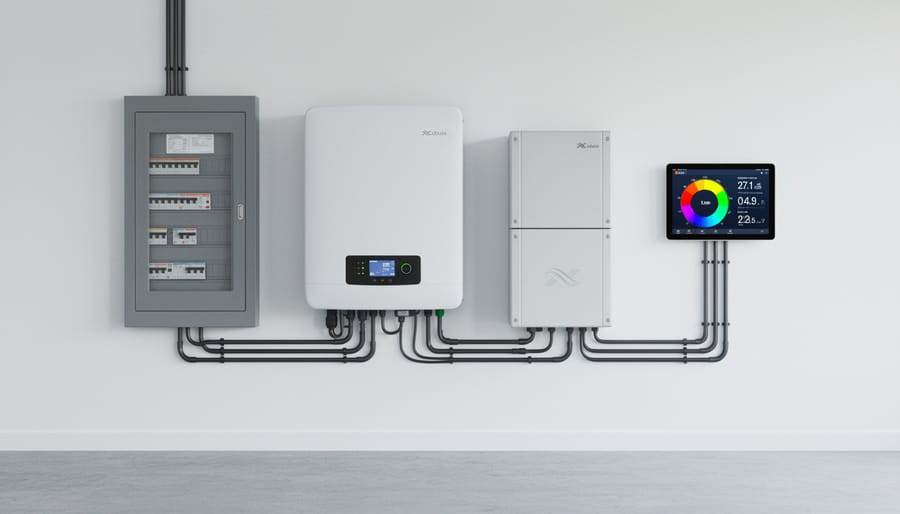
Inverters convert the DC electricity your panels produce into AC power your home uses. String inverters cost less ($1,000-$3,000 for a residential system) but treat all panels as one unit. Microinverters ($150-$300 per panel) optimize each panel individually and often justify their higher cost on partially shaded roofs or complex layouts.
Mounting equipment, the racking and hardware securing panels to your roof, runs $0.10-$0.30 per watt. Costs climb for specialty mounts on tile or metal roofs.
Battery storage adds $8,000-$15,000 to your system but isn’t necessary for grid-connected homes. Most homeowners skip batteries initially, adding them later if backup power becomes a priority.
Soft Costs: The Hidden Price Tag
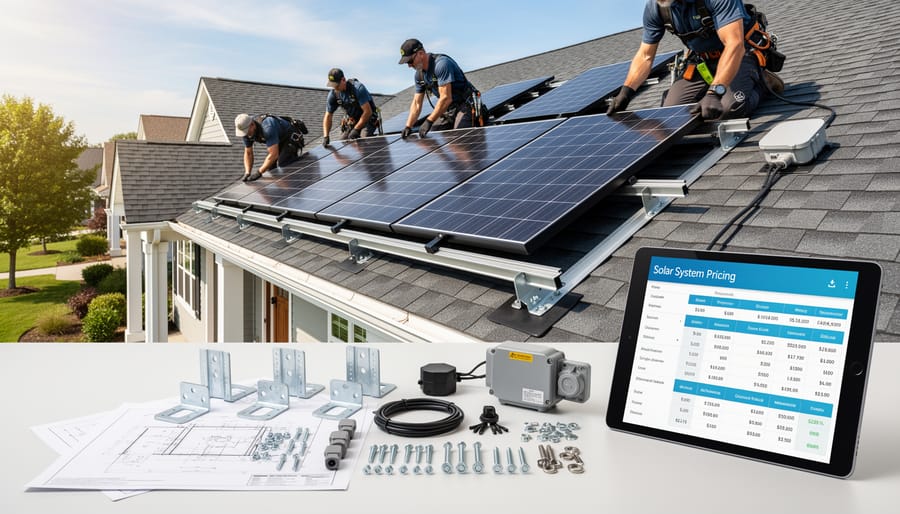
Soft costs explain why your neighbor’s quote doesn’t match yours, even with identical equipment. While solar panels and inverters grab attention, these behind-the-scenes expenses add up quickly. In fact, soft costs include permitting financing, installation labor, and the overhead that keeps solar companies running. They typically account for half or more of your total installation price.
Understanding these expenses helps you evaluate quotes more intelligently. Here’s where your money goes beyond the hardware:
- Permitting and inspections, Local government fees and electrical inspection costs to ensure code compliance
- Installation labor, Trained crews who mount panels, run conduit, and wire your system safely
- Financing arrangements, Loan processing fees and administrative costs if you’re not paying cash
- Customer acquisition, Marketing expenses and sales commissions that brought you to the installer
- Supplier overhead, Warehousing, insurance, and business operations that keep the company functioning
- Project management, Site assessments, engineering reviews, and coordination with your utility
These costs vary significantly by region and installer. A company with streamlined permitting relationships might charge less than one still learning your city’s requirements. Smaller installers often have lower customer acquisition costs but may lack volume discounts on permits. Meanwhile, cash purchases eliminate financing fees entirely, which is why they’re cheaper than solar loans or leases.
This is why comparing total installed price matters more than obsessing over panel brand. Two identical systems can differ by thousands based purely on how efficiently an installer handles these soft costs. Ask potential installers to break down their pricing. The ones willing to explain their numbers usually run tighter operations.
Factors That Influence Your Final Solar Installation Price
Your final solar installation price can swing thousands of dollars higher or lower than the $31,135 average depending on your property’s characteristics and the choices you make. Understanding which factors apply to your home helps you prepare for an accurate quote and avoid sticker shock.
What Your Property Brings to the Table
Your roof tells much of the price story before an installer even climbs up. A simple single-story ranch with an unobstructed south-facing slope costs far less to equip than a multi-story Victorian with dormers, valleys, and multiple roof planes. Complex rooflines require more mounting hardware, longer installation hours, and careful engineering to ensure panels sit securely through decades of weather.
The roof material matters, too. Asphalt shingle roofs are the easiest and cheapest to work with. Metal roofing adds moderate cost. Tile, slate, and cedar shake require specialized mounting techniques and extreme care to avoid damage, pushing labor costs higher. Steep roof angles slow installers down and sometimes demand additional safety equipment, again nudging the price upward.
Shading throws another variable into the mix. Trees, chimneys, neighboring buildings, or even your home’s own architectural features can cast shadows that reduce panel efficiency. Heavy shade might require fewer panels placed in premium sunny spots, microinverters instead of a string inverter to manage partial shading, or tree trimming before installation. Each solution carries its own cost.
Here are the key factors that influence your final price:
- Shading conditions, nearby trees, structures, or chimneys that reduce sunlight exposure and may require equipment upgrades or vegetation management
- Roof complexity, number of roof planes, dormers, valleys, and penetrations that increase installation time and materials
- Roof material and angle, asphalt shingles cost less to work with than tile or slate; steeper pitches slow installation
- Equipment tier, premium panels and inverters with better warranties and efficiency carry higher upfront costs
- Local incentive programs, state and utility rebates that can reduce your net price by thousands of dollars
Choices That Shape Your Investment
Beyond what your property dictates, you control the equipment tier. Budget panels get the job done. Mid-tier options balance cost and performance. Premium panels with higher efficiency ratings and 25-year warranties cost more per watt but generate more power in limited roof space and often carry stronger performance guarantees.
Battery storage is the biggest optional add-on. A home battery system for backup power or time-of-use optimization can add $10,000 to $15,000 to your project. Many homeowners start without batteries and add them later as prices drop or needs change.
Before you estimate your solar needs and request quotes, walk your property with these factors in mind. Identifying which variables apply to your situation prepares you for informed conversations with installers and realistic budget planning.
DIY vs. Professional Solar Installation: What’s Right for You?
DIY solar installation can slash your upfront costs, often by 30 to 50 percent compared to professional installation, but the savings come with substantial trade-offs that many homeowners underestimate. When you hire a professional installer, you’re paying for expertise, speed, proper permitting, warranty protection, and safety equipment. When you go DIY, you’re trading money for your own time, research, and risk.
The appeal is obvious: if professional installation runs around $2.60 per watt, a DIY approach might bring that down to $1.30 to $1.80 per watt by eliminating labor and overhead. On a typical 12 kW system, that’s a potential savings of $10,000 to $15,000. But those dollars translate directly into hours of your life spent learning electrical codes, climbing on your roof, navigating permitting bureaucracies, and troubleshooting when something doesn’t fit or connect as the instructions promise.
- Potential savings of 30-50% on total system cost by eliminating labor and company overhead.
- Complete control over equipment choices and installation timeline.
- Hands-on learning experience and deep understanding of your system.
- Requires significant electrical and carpentry skills, plus comfort working at heights.
- Time-intensive process that can stretch across weeks or months for a first-timer.
- Permitting and inspection processes are your responsibility and can be complex.
- Equipment warranties may be voided without certified installation.
- Safety risks include falls, electrical shock, and fire hazards if improperly installed.
Skill requirements matter more than most DIY enthusiasts expect. You need solid electrical knowledge, not just changing outlets, but understanding DC systems, inverter connections, grounding, and code compliance. You’ll work on a pitched roof in varying weather, mounting heavy panels and running conduit. If those tasks sound manageable, you still face the permitting gauntlet: utility interconnection agreements, building permits, electrical inspections, and in some areas, structural engineering sign-offs. Professional installers handle this paperwork daily; for a DIYer, it’s a one-time maze that can stall your project for months.
Warranty implications are critical. Most panel manufacturers require certified installation to honor their 25-year product warranties. Inverter companies often follow the same rule. If you install your own system and a panel fails in year seven, you might be on your own. Professional installers also carry liability insurance and workmanship warranties that cover installation errors, something you won’t have if you drop a panel through your roof or wire a junction box incorrectly.
The right choice depends on your honest assessment of your skills, available time, and risk tolerance. If you’re an experienced electrician with roofing skills and spare weekends, DIY might work. For most homeowners who value their time, safety, and long-term warranty protection, professional installation justifies its cost.
Making Solar Affordable: Financing and Payment Strategies
The $31,135 price tag for a typical 12 kW solar system feels steep, but paying that full amount upfront isn’t the only path forward. How you finance your installation affects your total cost just as much as the equipment you choose.
Cash purchases eliminate interest charges and keep your long-term costs lowest. You own the system immediately, qualify for all available incentives yourself, and skip monthly payments. If you have the savings available, this approach maximizes your financial return over the system’s 25-plus year lifespan.
Solar loans function like home improvement financing. You own the system from day one and claim any tax credits or rebates, but you’ll pay interest over the loan term. Compare total repayment amounts carefully. A five-year loan costs more monthly than a 20-year option, yet you’ll pay far less interest overall. Some lenders offer solar-specific products with deferred payment periods or flexible terms.
Leases and power purchase agreements (PPAs) require little or no money down. A solar company owns the equipment on your roof, and you either pay a fixed monthly lease amount or buy the electricity the panels produce at a set rate. You avoid maintenance responsibilities and upfront costs, but you also forfeit tax credits and ownership benefits. The company profits from the incentives instead. These arrangements can make sense if you want immediate savings without cash reserves, though you’ll pay more over time than with ownership.
Going off-grid with solar typically requires battery storage, which adds significantly to your financing needs but eliminates electric bills entirely.
Federal, state, and local programs change each year. Research current incentives available in your area before you commit to any financing structure. The Database of State Incentives for Renewables & Efficiency (DSIRE) tracks programs by location. Your installer should explain what’s available, but verify independently. Some programs reduce your system cost directly, while others provide tax credits you claim later.
Calculate your total payment over the full term for any financing option. The lowest monthly payment rarely equals the best deal.
Success Stories: Communities Going Solar
The Martinez family in suburban Phoenix made the jump to solar in 2025 after their summer electric bills hit $400. They spent three months getting quotes, learning about system sizes, and connecting with neighbors who’d already installed panels. Their biggest surprise? The soft costs added nearly 40% to the equipment price, covering permitting, installation labor, and interconnection fees they hadn’t anticipated.
What made their decision easier was joining a local solar co-op that negotiated group pricing with installers. By going in with eight other households on their block, they each saved about $2,800 compared to individual quotes. The co-op also shared a vetted installer who understood their city’s permitting quirks, cutting weeks off the approval process.
In rural Vermont, the Hillside Community Housing project took a different approach. Twenty families pooled resources to install a shared solar array on common land, then divided the output through virtual net metering. Their combined 240 kW system cost significantly less per household than twenty individual rooftop installations would have. They spent six months navigating state programs and utility agreements, but the effort paid off when residents began to avoid electric bills entirely during peak production months.
Both stories illustrate a crucial lesson: community engagement transforms solar from an intimidating capital expense into a manageable group effort. The families learned from each other’s research, shared installer experiences, and collectively navigated the complexities of system sizing and local incentives. Their advice? Find others in your area already running solar, ask blunt questions about total costs and challenges, and consider group purchasing if your state allows it.
Frequently Asked Questions About Residential Solar Costs
Is solar worth the cost in 2026?
For most homeowners, yes. While the upfront cost for a typical 12 kW system averages $31,135 before incentives, solar panels generate free electricity for 25-30 years. When you factor in state and local programs that can reduce the price by thousands of dollars, plus decades of reduced or eliminated electric bills, the long-term savings typically outweigh the initial investment.
How long until my solar system pays for itself?
Payback periods vary widely based on your electricity rates, system cost, and available incentives, but most homeowners see a return on investment within 7-12 years. Homes in areas with high electricity costs and generous state programs often recover their investment faster, while those in regions with lower rates may take longer.
What ongoing costs should I expect after installation?
Solar systems require minimal maintenance. You might need to clean panels occasionally if debris accumulates, and inverters typically need replacement after 10-15 years (costing a few thousand dollars). Most systems come with 25-year warranties on panels and 10-year warranties on inverters, which cover major failures during those periods.
Do I need to replace my roof before installing solar panels?
If your roof is nearing the end of its lifespan, replace it first. Removing and reinstalling panels later costs several thousand dollars in labor. A sturdy roof in good condition can easily support panels for their 25-30 year lifespan, but roof complexity and type do affect installation costs.
The decision to invest in solar often comes down to your specific situation: your current electricity costs, roof condition, and long-term plans for your home. Some homeowners choose solar to power off grid and achieve complete energy independence, while others simply want to reduce monthly bills and contribute to community sustainability efforts.
Finding qualified local installers starts with researching installers who know your state’s specific programs and permitting requirements. Get quotes from at least three companies, compare their pricing at the $2.60 per watt baseline, and ask about their experience with projects similar to yours. Local installers understand regional variables like shading patterns, roof types common in your area, and which equipment performs best in your climate. They also navigate your municipality’s permitting process regularly, which streamlines installation and ensures you access every available local incentive.
Cost by primary variable
The biggest driver of your residential solar system cost is system size, measured in kilowatts. A typical 12 kW installation averages $31,135 before incentives, but your actual needs might be smaller or larger depending on your household’s electricity consumption.
Here’s how costs typically scale at the average rate of $2.60 per watt:
A 6 kW system (smaller home, lower usage) runs about $15,600.
An 8 kW system (average suburban home) costs around $20,800.
A 12 kW system (larger home or higher consumption) averages $31,135.
A 15 kW system (large home or very high usage) comes in near $39,000.
Your location significantly impacts these baseline figures. State and local programs can reduce your out-of-pocket costs by thousands of dollars, making regional research essential before budgeting. Site-specific factors like roof complexity, shading, and your choice of equipment quality also push the final number up or down from these averages, but system size remains the primary cost variable you control.
Step Sequence
Understanding the cost is just the beginning, here’s how to move from research to a functioning solar system on your roof:
- Calculate your energy needs: Review your past 12 months of electricity bills to determine your average monthly consumption in kilowatt-hours. Most homes need about 12 kW of capacity, but your specific usage will guide the right system size.
- Research your state and local incentives: Check your state energy office website and local utility programs for rebates, tax credits, and other financial assistance. These programs can reduce your total cost by thousands of dollars.
- Get multiple quotes from installers: Contact at least three local solar companies for detailed proposals. Compare not just the bottom-line price but also equipment quality, warranties, and company reputation.
- Review and compare proposals: Examine each quote’s breakdown of hardware costs versus soft costs, including permitting, installation labor, and financing terms. Confirm that all necessary permits and inspections are included.
- Secure financing if needed: If you’re not paying cash, finalize your loan, lease, or power purchase agreement before signing the installation contract. Compare total costs over the system’s lifetime.
- Schedule installation and permitting: Your installer will handle permits and utility interconnection paperwork. Installation typically takes one to three days once permits are approved.
After installation, your system will need final inspection and utility approval before it can start generating power. Most homeowners see their systems activated within two to four weeks of installation completion, at which point you’ll begin offsetting your electricity costs and contributing to your community’s renewable energy goals.
Understanding that a typical 12 kW residential solar system costs around $31,135 before incentives, or roughly $2.60 per watt, gives you a solid starting point for planning your solar investment. But the real number you’ll pay depends on where you live, what your roof looks like, and which local programs you can access. State and local incentives can reduce your out-of-pocket costs by thousands of dollars, so your next step is to research what’s available in your area right now.
Going solar isn’t just a financial decision. It’s a commitment to energy independence and a cleaner future for your community. When you install solar panels, you’re joining neighbors who’ve already made the shift, creating momentum for renewable energy adoption in your region. That collective impact matters, every installation makes the next one easier and more affordable.
Start by getting quotes from at least three local installers to see how your specific situation affects pricing. Ask about current state programs, financing options, and whether there are community solar initiatives in your area that you can join or learn from. Talk to neighbors who’ve gone solar. Their real-world experience with local installers and programs is invaluable.
The transition to solar power starts with understanding the costs, but it moves forward when you take action. Your research today could lead to decades of clean energy and lower electricity bills tomorrow.