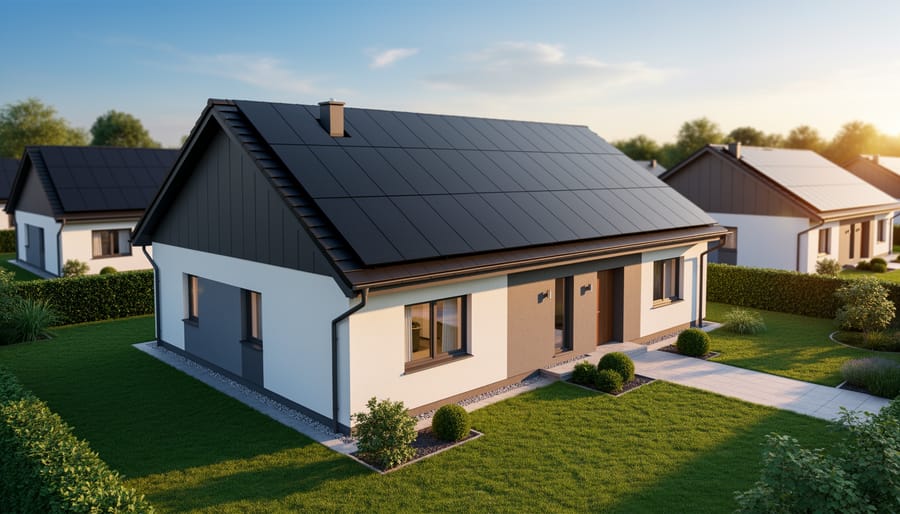
Calculate your home’s monthly electricity consumption by reviewing your utility bills from the past year, then divide that number by 30 to get your daily kilowatt-hour usage. A typical American household uses 30 kilowatt-hours per day, requiring between 15 to 25 solar panels depending on panel wattage and your location’s sun exposure.
Multiply your daily energy needs by 0.25 to account for system inefficiencies, then divide by your area’s average peak sun hours. In sunny California, you might need fewer panels than in cloudier Seattle for the same energy production. Most residential systems range from 5 to 10 kilowatts, with each 400-watt panel producing roughly 1.5 kilowatt-hours daily in optimal conditions.
Consider your roof’s available space and orientation before finalizing system size. South-facing roofs in the Northern Hemisphere capture maximum sunlight, while shading from trees or neighboring buildings can reduce panel efficiency by 20 to 30 percent. Most residential panels measure about 17.5 square feet, meaning a 20-panel system requires approximately 350 square feet of unobstructed roof space.
Real families across the country have successfully made this transition. The Martinez family in Arizona offset 95 percent of their electricity bills with just 18 panels, while the Chens in Massachusetts needed 24 panels for similar results due to regional climate differences. These success stories demonstrate that going solar works regardless of location when you properly size your system.
Start by requesting quotes from three local installers who can conduct detailed site assessments and provide customized recommendations based on your specific energy goals and budget.
Understanding Your Home’s Energy Appetite
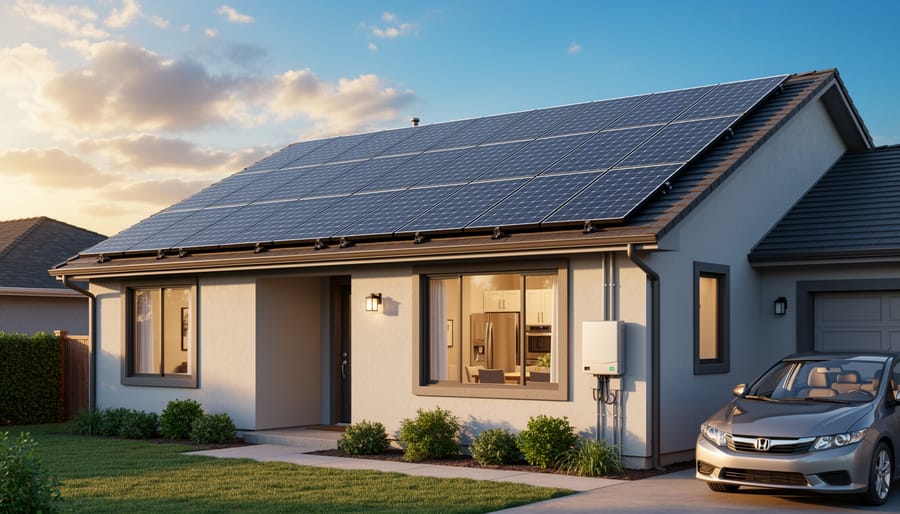
Finding Your Monthly Energy Usage
Understanding your household’s energy consumption is the essential first step in determining how many solar panels you’ll need. Your electricity bill contains all the information you need to get started, and gathering this data is simpler than you might think.
- Locate your most recent electricity bill and find the section showing kilowatt-hours (kWh) used during the billing period.
- Collect bills from the past 12 months if possible, as energy usage fluctuates significantly between seasons.
- Add up the total kWh used across all 12 months.
- Divide this total by 12 to calculate your average monthly consumption.
This year-long approach accounts for seasonal variations—your air conditioning in summer and heating in winter create peaks and valleys in energy use. Most households discover their consumption ranges from 500 to 1,500 kWh monthly, though your number may differ based on home size, climate, and lifestyle.
If you can’t find a full year of bills, contact your utility company directly. Many now offer online portals where you can access detailed usage history and even see daily consumption patterns. The Martinez family in Colorado Springs found their utility’s mobile app revealed surprising energy spikes during weekday afternoons, helping them better understand their needs before going solar. This groundwork ensures your solar system will be sized accurately for your household’s unique energy fingerprint.
What Affects Your Energy Needs
Understanding your household’s energy needs is the essential first step in determining how many solar panels you’ll require. Every home is unique, and several interconnected factors shape your consumption patterns.
Home size plays a significant role, but it’s not just about square footage. A well-insulated 2,000-square-foot home might use less energy than a poorly insulated 1,500-square-foot house. The quality of your insulation, window sealing, and overall building envelope determines how hard your heating and cooling systems must work throughout the year.
The number of occupants directly impacts energy use. More people typically means more lighting, hot water usage, laundry loads, and electronic devices running simultaneously. A family of five will naturally have different needs than a couple living in a similar-sized home.
Your climate zone significantly affects consumption. Homes in Phoenix face different challenges than those in Minnesota. Extreme temperatures in either direction increase heating or cooling demands, while moderate climates often enjoy lower baseline energy needs.
Appliance efficiency matters tremendously. Older refrigerators, water heaters, and HVAC systems can consume two to three times more electricity than modern, energy-efficient models. Improving home energy efficiency before installing solar panels means you’ll need fewer panels overall, reducing your upfront investment.
The Martinez family in Colorado discovered this firsthand. After upgrading their insulation and replacing aging appliances, their energy needs dropped 30 percent, allowing them to install a smaller, more affordable solar array that still meets 100 percent of their needs.
How Solar Panels Generate Power

Standard Panel Sizes and Outputs
Modern solar panels come in several standard wattages, and understanding these options helps you plan your home energy system effectively. Today’s residential panels typically range from 250W to over 400W per panel, with most homeowners choosing panels between 300W and 370W. These numbers represent the maximum power output under ideal conditions—essentially, how much electricity each panel can generate during peak sunlight hours.
| Panel Wattage | Typical Dimensions | Daily Output (4-5 sun hours) | Best For |
|---|---|---|---|
| 250-300W | 65″ x 39″ | 1-1.5 kWh | Smaller homes, budget-conscious families |
| 300-350W | 66″ x 40″ | 1.2-1.75 kWh | Average homes, most popular choice |
| 370-400W+ | 67″ x 40″ | 1.5-2 kWh | Limited roof space, efficiency seekers |
Higher-wattage panels cost more upfront but require fewer total panels, which can reduce installation complexity and costs during the solar installation process. For example, the Martinez family in California chose 350W panels and needed only 18 panels to power their home, while their neighbors using 300W panels required 21 panels for similar output. Consider your roof space, budget, and long-term energy goals when selecting panel wattage for your sustainable energy journey.
The Solar Panel Calculation Formula
Working Through a Real Example
Let me walk you through a real-world example that brings these calculations to life. Meet the Johnson family from Denver, Colorado—a household of four living in a 2,000-square-foot home who made the switch to solar last year.
The Johnsons started by reviewing their electricity bills and found they used about 900 kilowatt-hours monthly, or roughly 10,800 kWh annually. They live in an area receiving approximately 5.5 peak sun hours daily, which is fairly typical for Colorado’s sunny climate.
Using the formula we discussed earlier, here’s how their calculation worked: 10,800 kWh divided by 365 days equals about 29.6 kWh needed daily. Dividing that by 5.5 peak sun hours gives them 5.38 kilowatts of required system capacity. After accounting for a 25% efficiency loss, they needed approximately 6.7 kilowatts total.
The Johnsons chose 350-watt panels, which are common in today’s market. Dividing 6,700 watts by 350 watts per panel meant they needed 19 panels to meet their energy needs. Their installer placed 20 panels on their south-facing roof to maximize production year-round.
Within the first year, the family noticed their electricity bills dropped to nearly zero during summer months. Sarah Johnson shares that seeing their meter run backward on sunny days became a small but meaningful celebration for the whole family. Their system not only powers their home but represents their commitment to a cleaner, more sustainable future for their community.
Location Makes All the Difference
Sunshine Hours and Your Region
The amount of sunshine your home receives dramatically impacts how many solar panels you’ll need to generate the same amount of electricity. This concept, measured in peak sun hours, represents the equivalent number of hours per day when sunlight reaches 1,000 watts per square meter—the standard condition used for rating solar panels.
A home in Phoenix, Arizona, receiving an average of 6.5 peak sun hours daily will need significantly fewer panels than an identical home in Seattle, Washington, which receives only 3.5 peak sun hours. This regional variation is one of the most important factors in determining your system size, and the good news is that solar works everywhere—it just requires a bit more roof space in cloudier climates.
| Region | Average Peak Sun Hours | Panels Needed (8,000 kWh/year) |
|---|---|---|
| Southwest (Arizona, Nevada) | 5.5-6.5 hours | 18-21 panels |
| Southeast (Florida, Georgia) | 4.5-5.5 hours | 21-25 panels |
| Northeast (New York, Maine) | 3.5-4.5 hours | 25-30 panels |
| Pacific Northwest (Washington, Oregon) | 3.0-4.0 hours | 28-35 panels |
To find your local solar data, visit the National Renewable Energy Laboratory’s PVWatts Calculator, which provides free, detailed solar resource information for any address in the United States. Your local solar installer can also provide this data during consultations. Don’t let a cloudy reputation discourage you—many Pacific Northwest communities have embraced solar successfully, proving that commitment to clean energy transcends geography.
Roof Orientation and Shading
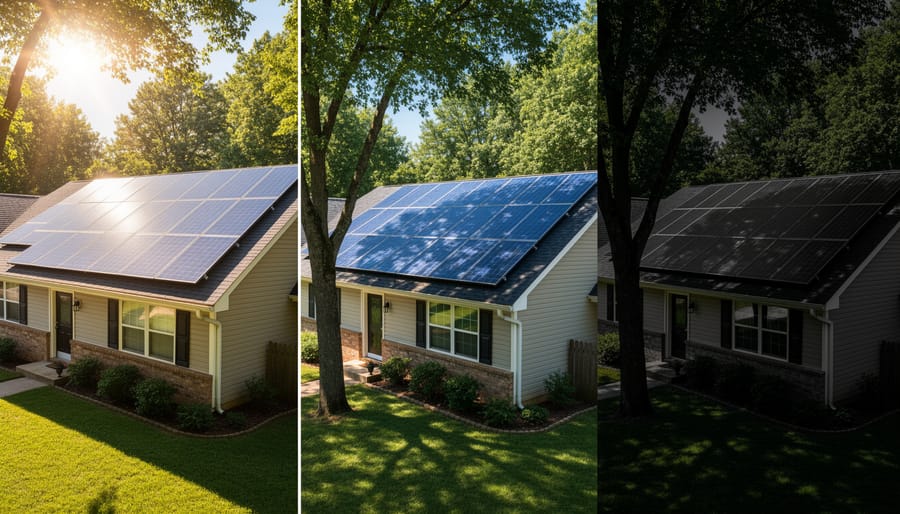
Your roof’s orientation and shading patterns significantly influence how many solar panels you’ll need to power your home. South-facing roofs in the Northern Hemisphere typically receive the most sunlight throughout the day, making them ideal for solar installations. If your roof faces east or west, you might need 10-20% more panels to generate the same amount of electricity. North-facing installations generally aren’t recommended due to limited sun exposure.
Roof angle matters too. The optimal tilt varies by location, but roofs angled between 30-40 degrees often perform well. Fortunately, modern solar technology has become increasingly efficient at various angles, so many existing roof pitches work just fine without modifications.
Shading presents the biggest challenge. Even partial shade from trees, chimneys, or neighboring buildings can reduce your system’s output by 25% or more. Before installation, solar professionals conduct shade analyses throughout different seasons. The Johnson family in Portland discovered that trimming two large oak trees increased their solar potential by 40%, allowing them to install fewer panels while still meeting their energy goals. Sometimes strategic tree management or relocating panels to sunnier roof sections makes all the difference. If shading is unavoidable, microinverters or power optimizers can minimize the impact on your entire system’s performance.
Typical Panel Counts for Different Homes
Understanding how many panels you’ll need becomes much clearer when you look at real-world examples. Let’s explore typical scenarios for different home sizes to give you a practical starting point for your solar journey.
A small home or apartment, typically around 1,000 square feet with modest energy consumption, usually requires between 8 to 12 solar panels. These homes often house one to two people with lower heating and cooling demands, making them ideal candidates for compact solar installations that can still deliver impressive energy independence.
Medium-sized homes, ranging from 1,500 to 2,500 square feet, represent the most common residential solar installations. These family homes typically need 15 to 20 panels to cover their energy needs. The Johnson family in Portland, Oregon installed 18 panels on their 2,000 square foot home and now covers 95% of their annual electricity usage, even through cloudy winter months. They’ve become neighborhood advocates for solar energy, hosting community meetings to share their experience and encourage others to make the switch.
| Home Size | Monthly Usage (kWh) | Panels (Sunny Climate) | Panels (Moderate Climate) |
|---|---|---|---|
| Small (1,000 sq ft) | 500-700 kWh | 8-10 | 10-12 |
| Medium (2,000 sq ft) | 900-1,200 kWh | 15-18 | 18-22 |
| Large (3,000+ sq ft) | 1,500-2,000 kWh | 25-30 | 30-35 |
Large homes exceeding 3,000 square feet with multiple family members, home offices, or electric vehicle charging typically require 25 to 35 panels. While this represents a larger upfront investment, these households often see the most dramatic utility bill savings. Regional differences matter significantly here. A large home in sunny Arizona might need 28 panels, while an identical home in cloudy Seattle could require 35 panels to generate the same energy output.
These numbers serve as helpful guidelines, but remember that your actual needs depend on your specific energy consumption patterns, roof characteristics, and local sunlight availability. Getting quotes from local installers will provide personalized recommendations for your situation.
Do You Need to Cover 100% of Your Usage?
Here’s the reality: you don’t have to cover 100% of your household’s energy needs with solar panels to see meaningful benefits. Many homeowners find that offsetting 60-80% of their electricity usage strikes the perfect balance between environmental impact and upfront investment costs.
Grid-tied systems have made partial solar adoption both practical and financially smart. When your panels produce more electricity than you need during sunny days, the excess flows back to the grid. Through net metering programs available in most states, your utility company credits you for this surplus energy, which you can draw upon during evenings or cloudy days. This arrangement means you’re still connected to the grid as a backup, eliminating concerns about running out of power.
The beauty of this approach is flexibility. Maybe you start by installing enough panels to cover your daytime usage, then add more panels as your budget allows. Many families in communities nationwide have taken this gradual approach, celebrating each step toward energy independence without the pressure of going all-in immediately.
Consider the Johnson family in Portland, who installed a system covering 70% of their annual usage. They reduced their electric bills by nearly $150 monthly while maintaining grid access for reliability. Their story reflects a growing trend: households prioritizing substantial savings and environmental benefits without the complexity of complete off-grid living.
For those pursuing full energy independence with battery storage, the investment increases significantly. However, most sustainability-focused families find that smart grid-tied systems deliver impressive results. You’re reducing carbon emissions, lowering utility costs, and supporting renewable energy growth in your community—all while keeping your home’s energy supply reliable and manageable. The question isn’t whether to go solar, but rather what percentage makes sense for your family’s goals and budget.
Space Constraints and Roof Capacity
Before you finalize your solar panel count, you’ll need to ensure your roof can actually accommodate them. Most residential solar panels measure about 17-18 square feet each, so a typical 20-panel system requires roughly 350 square feet of unshaded roof space. Remember to account for necessary spacing between panels and around roof edges for safe installation and maintenance access.
Start by evaluating your roof’s orientation and condition. South-facing roofs receive optimal sunlight in the Northern Hemisphere, but east and west-facing sections can work well too. Your roof should also be structurally sound enough to support the additional weight, typically 2-4 pounds per square foot for panels and mounting equipment. If your roof needs replacement soon, consider doing that before installing panels to avoid the cost of removing and reinstalling your system later.
What if your roof space falls short? Many homeowners have found creative solutions. Ground-mounted systems work beautifully for properties with available yard space, and some communities have even organized shared solar gardens where multiple households invest in a collectively-owned array. The Martinez family in Colorado, for example, partnered with three neighbors to install a ground-mounted system in an unused corner of their shared community space, splitting both costs and energy benefits.
Carports, pergolas, and garage roofs also present excellent alternative mounting locations. These options can actually serve double duty, providing shade for vehicles or outdoor living spaces while generating clean energy. Don’t let limited roof space discourage you from exploring solar possibilities for your home.
Real Families, Real Solar Stories
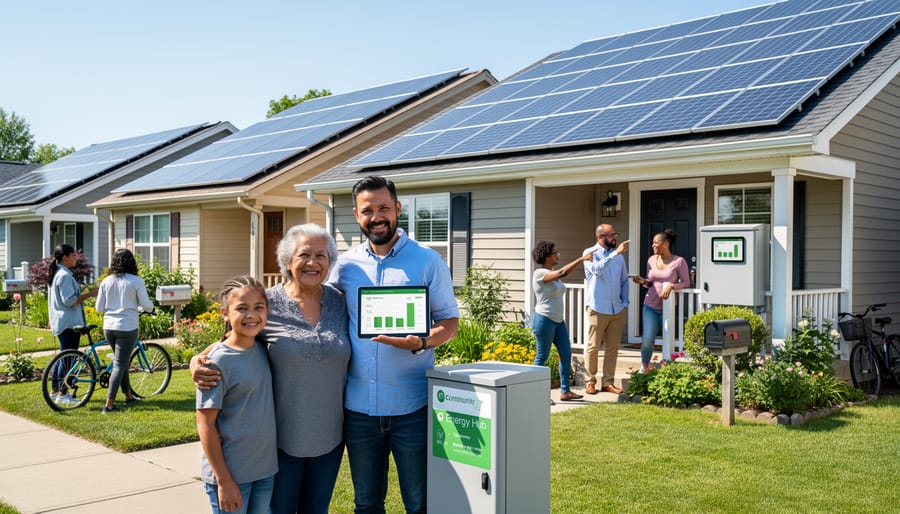
When the Martinez family in suburban Phoenix started researching solar panels, they felt overwhelmed by the technical details. “We just wanted to know if it would actually work for our home,” recalls Maria Martinez. Their 2,400-square-foot home needed 24 panels to cover their annual electricity use of about 11,000 kWh. The biggest challenge wasn’t the technology—it was navigating financing options and finding trustworthy installers. Through their neighborhood sustainability group, they connected with three other families who had recently gone solar. These neighbors shared their experiences, reviewed contracts together, and even negotiated a group discount with a local installer. Two years later, the Martinez family has eliminated their electric bill entirely and inspired six more households on their street to make the switch.
Across the country in Vermont, retired teacher Robert Chen took a different approach to his solar journey. His smaller 1,600-square-foot home required just 16 panels to meet his modest energy needs of 7,200 kWh annually. Robert’s main obstacle was the upfront cost on a fixed income. He discovered that his town offered a community solar program and local credit union financing specifically for renewable energy projects. “I wish I’d known about these resources sooner,” he shares. By attending a local renewable energy fair, Robert also learned about state rebates that reduced his installation costs by 30 percent. His panels have been producing clean energy for three years now, and he volunteers at community workshops to help others navigate the financial aspects of going solar.
The Thompson family in North Carolina faced unique challenges with their 3,200-square-foot home and heavy air conditioning use. Their system required 28 panels to offset their 13,500 kWh annual consumption. Initially discouraged by quotes that seemed too expensive, they joined an online community forum where members shared cost-saving strategies and installer recommendations. They learned to compare multiple bids and ask detailed questions about equipment warranties. The support they received from both online communities and local environmental groups made all the difference. Today, they host quarterly neighborhood gatherings to share their monitoring data and answer questions from curious neighbors considering solar energy for their own homes.
Taking the Next Steps in Your Solar Journey
Now that you’ve calculated how many solar panels you might need, it’s time to turn your research into action. The most important next step is getting a professional solar assessment for your specific home. While online calculators provide helpful estimates, a certified installer can evaluate your roof’s condition, shading patterns throughout the day, and electrical system capacity—factors that significantly impact your final system design.
Start by connecting with your local solar community. Many neighborhoods have sustainability groups or community solar cooperatives where members share their experiences with different installers and financing options. These connections often lead to valuable insights you won’t find in marketing materials. The Martinez family in Colorado credits their local green living group for helping them navigate solar incentives and rebates they didn’t know existed, saving them over $5,000.
When interviewing installers, ask about their experience with homes similar to yours, warranty coverage, and projected timeline from consultation to activation. Request at least three quotes to compare system sizes, equipment quality, and pricing. Don’t hesitate to ask why they’re recommending specific panel types or inverter configurations—reputable installers welcome these questions.
Inquire about monitoring systems that track your energy production and post-installation support for maintaining your solar panels. Understanding the company’s customer service reputation matters just as much as their installation expertise.
Remember, going solar is a significant investment in your home and our planet’s future. Taking time to find the right partner for your solar journey ensures you’ll enjoy clean, renewable energy for decades to come while inspiring others in your community to explore sustainable living.
While the calculations and guidelines shared here provide solid estimates for sizing your solar array, remember that every home’s journey to solar energy is unique. A professional solar assessment will account for nuances your initial estimates might miss—from shading patterns to roof angles and local utility policies. These experts can transform rough numbers into a customized roadmap for your household.
But here’s what matters most: taking that first step. Whether you start with two panels or twenty, you’re joining a growing movement of families choosing energy independence. Each solar installation strengthens community resilience, reduces our collective carbon footprint, and demonstrates that sustainable living is both practical and achievable. Your neighbor notices when you go solar. Your kids learn that individual actions create meaningful change.
The calculations you’ve learned today empower you to have informed conversations with installers and make decisions aligned with your values and budget. Don’t let perfect be the enemy of good—even a partial solar system moves you toward greater energy independence while inspiring others in your community. Connect with local solar co-ops or sustainability groups to share experiences and learn from those who’ve already made the switch. Your solar journey starts now, and the environmental stewardship you’re embracing today creates ripples that extend far beyond your rooftop.