linda

Close-up of a green seedling in rich soil with a rusty chain wrapped around its stem, lit by warm evening light, with a blurred background of garden beds and hints of artificial turf.

Stop. Before you consider Private Blog Networks (PBNs) like Hetneo for your sustainable living blog, understand this: they promise quick SEO gains but deliver long-term damage that directly contradicts everything your community stands for.
PBNs involve creating or purchasing networks of low-quality websites solely to manipulate search rankings through artificial backlinks. While marketers tout benefits like “instant authority” and “controlled anchor text,” these tactics violate Google’s guidelines and risk severe penalties including complete deindexing. More importantly, they’re fundamentally dishonest—the antithesis of the authentic, transparent values that define sustainable living.
Your blog exists to inspire genuine change through real …

Read More
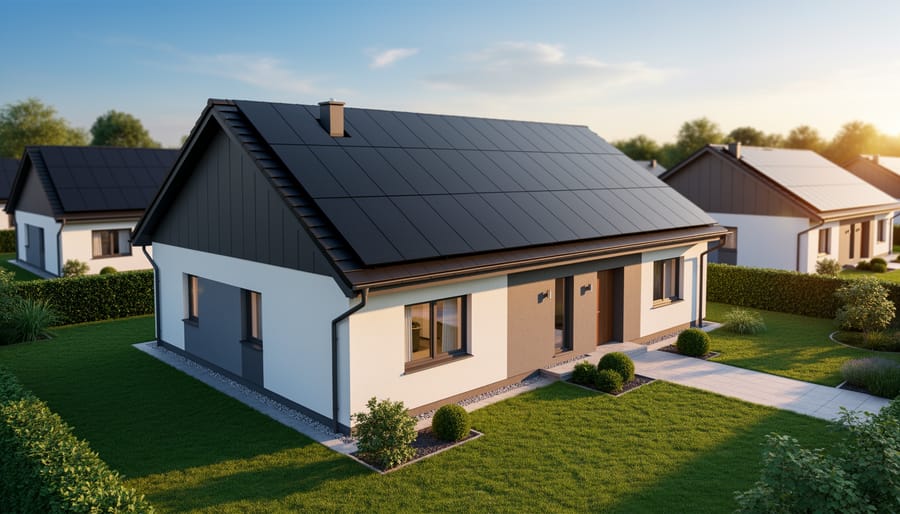
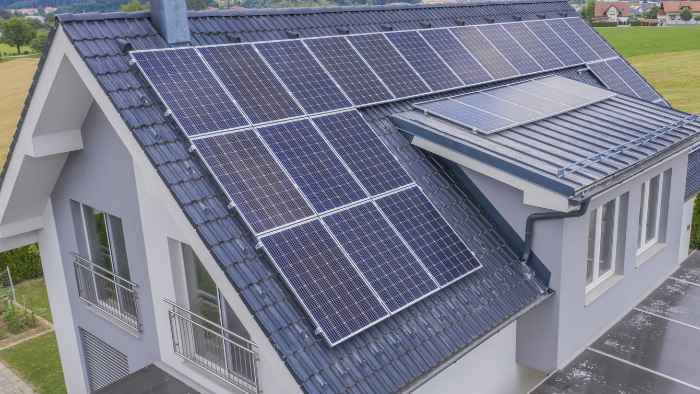
Elevated view of a modern house with a south-facing roof covered in dark monocrystalline solar panels, lit by golden-hour sunlight, with yard, neighboring rooftops, trees, and soft sky in the background.

Calculate your home’s monthly electricity consumption by reviewing your utility bills from the past year, then divide that number by 30 to get your daily kilowatt-hour usage. A typical American household uses 30 kilowatt-hours per day, requiring between 15 to 25 solar panels depending on panel wattage and your location’s sun exposure.
Multiply your daily energy needs by 0.25 to account for system inefficiencies, then divide by your area’s average peak sun hours. In sunny California, you might need fewer panels than in cloudier Seattle for the same energy production. Most residential systems range from 5 to 10 kilowatts, with each 400-watt panel producing roughly 1.5 kilowatt-hours daily in optimal conditions.
Consider your roof’s available space and orientation before finalizing system size. South-…

Read More

The truth about salt-free water softeners is surprising. Despite the name, salt-free water softeners don’t exist in the UK or anywhere else! Instead, what we call “salt-free water softeners” are water conditioners. Here are the pros and cons of salt-free water softeners.
How Do Salt-free Water Softeners Work?
The water softener removes the excess minerals in hard water and replaces them with sodium ions. Salt is a critical tool in water softening systems for ion exchange.
Salt-free water softeners like Springwell Futuresoft (also called water conditioners) are water filtration systems that crystallize excess minerals (magnesium and calcium) in hard water. So, while salt-based softeners do the whole job of getting …

Read More

It’s interesting to know that out of all students in the U.S, less than 6% are enrolled at schools using solar energy. Admittedly, the U.S is one of the countries with a significant amount of educational institutions paying attention to solar power today. As a result, the schools can enjoy the numerous benefits of solar energy installation.
According to educators, a notable benefit derived from solar installation on school buildings is cost-effectiveness. School buildings usually have extensive roofs and tons of parking lot space with direct exposure to the sun. So schools can be a significant resource for tapping sustainable energy that can benefit their localities.
So what are the

Read More

From last February’s Texas snowstorm to the incessant Californian wildfires and the heatwaves hitting the Pacific Northwest — current events show that the climate crisis is worsening. Unsurprisingly, a recent GlobeScan and BBMG survey revealed that younger generations are keener on sustainable living. One way they are doing so is by investing in greener ways to consume electricity.
Notably, this includes small-scale solar power systems, and more homeowners are installing them for reasons that go beyond promoting sustainability. So if you’re an American homeowner, you might want to consider switching to solar, too.
It’s cheaper than…

Read More

The number of companies shifting toward solar energy has increased significantly in recent years. With the coinciding rise of solar-powered generators across the globe, this transition has to do primarily with carbon footprint reduction.
Meanwhile, a couple of households have chosen to install solar panels on their abodes to save a lot on utility bills. This is a crucial reason why solar power has become an increasingly popular and practical renewable energy source.
Additionally, solar power yields many other benefits for the environment. Here are the top five advantages of solar energy on our planet.
1. Reduced Water Use
Water is one of our most important natural resources. Unfortunately, the world might be heading into freshwater depletion a few decades from now.
Water is mainly used for generator…

Read More

We all know that solar energy is one of the main alternative sources of electricity. It’s renewable, free, and has wide ranges of operation. This means that you can have a portable setup that harnesses solar energy or can build a large solar farm that can supply an entire city.
With that said, thoughts about being independent might enter your mindset. It’s only normal, especially when you can see how sustainable the solar energy systems are. However, is solar energy sufficient enough as a source when you go off the grid?
Can Solar Get You Off the Grid?
Generally, assuming that your solar energy system is planned according to your area’s dimensions, regular consumption rate, and availability of …

Read More

The post-COVID-19 era has left small businesses penniless, some closed, and some retrenched employees. The local economy has been massively displaced, and the pandemic has created unemployment to a great extent. Luckily for some who have lost their jobs have ventured into small scale business.
It takes the entire community to help regain the local business momentum. Economic and social growth come hand in hand; thus, promoting the local economy is not the sole responsibility of the government, but most importantly, it takes the help of ordinary citizens. Here are some examples of what we can do to achieve a sustainable local economy:

Rather than shop from malls, buy small scale stores.
Support individual businesses by buying from them. These can be any homemade products.
Start urban gardening to …

Read More

Now that the lockdown has eased up in most parts of the world, people are slowly going back to their pre-pandemic life. But the big question is, will the world still be the same after the pandemic? Here are reflections from some prominent thinkers.
Here’s what to expect for the post Covid-19 society:

Daniel Susskind, an economist from Oxford University, said that the world would only look significantly different. The problems we will face in the future will simply be more extreme than what we had.
James Manyika, chairman, and director of the McKinsey Global Institute, projections include the amplification of remote working and learning, telemedicine, and delivery service.
Shan Burrow, the International Trade Union Confederation general secretary, reflected on a more inclusive, resilient, and …

Read More