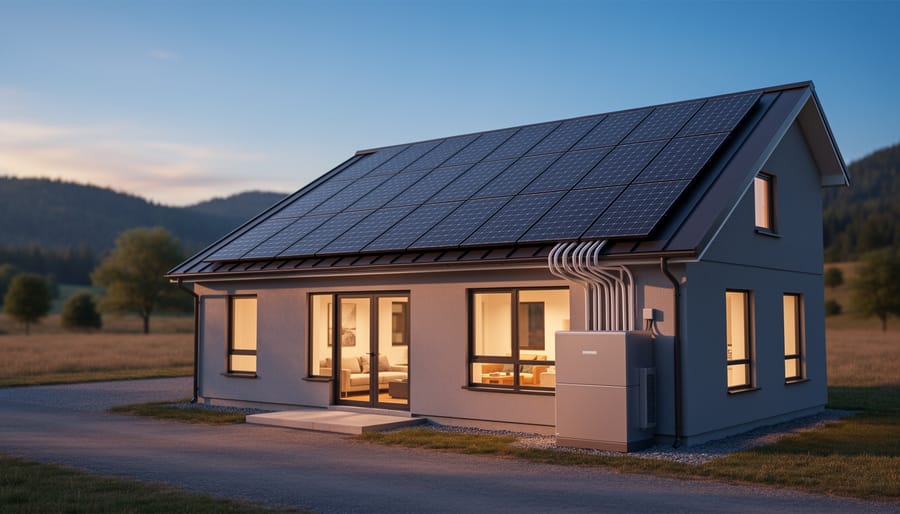
Imagine waking up to a power outage in your neighborhood while your lights stay on, your coffee brews, and your workday continues without interruption. That’s the reality for thousands of families who’ve installed off-grid solar power systems, achieving true energy independence while reducing their environmental footprint.
Off-grid solar represents a fundamental shift from traditional grid-tied systems. Instead of remaining tethered to utility companies, you generate, store, and manage 100% of your electricity needs. This means no more monthly electric bills, no vulnerability to grid failures, and complete control over your energy future. The technology has evolved dramatically in recent years, with battery storage costs dropping and system efficiency soaring, making off-grid living more accessible than ever in 2026.
The Martinez family in rural Colorado made the leap three years ago. “We were spending $280 monthly on electricity, plus dealing with frequent outages,” Maria Martinez shares. “Now we produce all our power, and our only energy cost is occasional maintenance.” Their story isn’t unique. From mountain cabins to suburban homes, people are discovering that off-grid solar isn’t just for survivalists or remote locations anymore.
This comprehensive guide walks you through everything you need to know about off-grid solar systems. You’ll learn how to calculate your energy needs, choose the right components, understand real costs beyond the sticker price, and hear from families who’ve successfully made the transition. Whether you’re planning a new build or retrofitting an existing home, you’ll find the practical information and encouragement needed to determine if energy independence is right for you.
What Makes an Off-Grid Solar System Different from Grid-Tied Systems
The core difference between off-grid and grid-tied solar systems comes down to one word: independence. A grid-tied system keeps you plugged into utility power, using solar to reduce your electric bill while the grid acts as your backup. An off-grid home solar power system severs that connection entirely, making you the sole manager of every watt your household uses.
Grid-tied systems send excess solar production back to the utility through net metering, essentially using the grid as free storage when sun isn’t shining. When your panels produce more than you need, the meter spins backward. When production drops at night, you draw from the grid. Simple, cost-effective, and you never worry about running out of power.
Off-grid systems replace that utility safety net with batteries, lots of them. Your solar panels charge a battery bank during sunny hours, and that stored energy powers your home when production stops. No grid means no fallback, which demands careful system sizing, robust battery capacity, and often a backup generator for extended cloudy stretches or unexpected high-demand periods.
| Factor | Off-Grid System | Grid-Tied System |
|---|---|---|
| Energy Independence | Complete autonomy from utilities | Partial; relies on grid for backup |
| Battery Requirements | Essential, large capacity needed | Optional or minimal |
| Upfront Cost | $25,000-$60,000+ | $15,000-$30,000 |
| Ongoing Maintenance | Higher; batteries need replacement | Lower; fewer components |
| Best For | Remote locations, energy sovereignty goals | Urban/suburban homes with grid access |
Why choose off-grid when grid-tied is cheaper? Location drives many decisions, homes beyond utility lines have no choice. But philosophy matters too. Off-grid appeals to those seeking genuine energy sovereignty, freedom from rate hikes, and resilience against grid failures. Some communities value the self-reliance and skills that come from managing their own power production.
The tradeoff is responsibility. You’ll monitor battery levels, adjust consumption during low-sun periods, and maintain backup systems. There’s no calling the power company when something breaks. For many, that trade feels worth making.
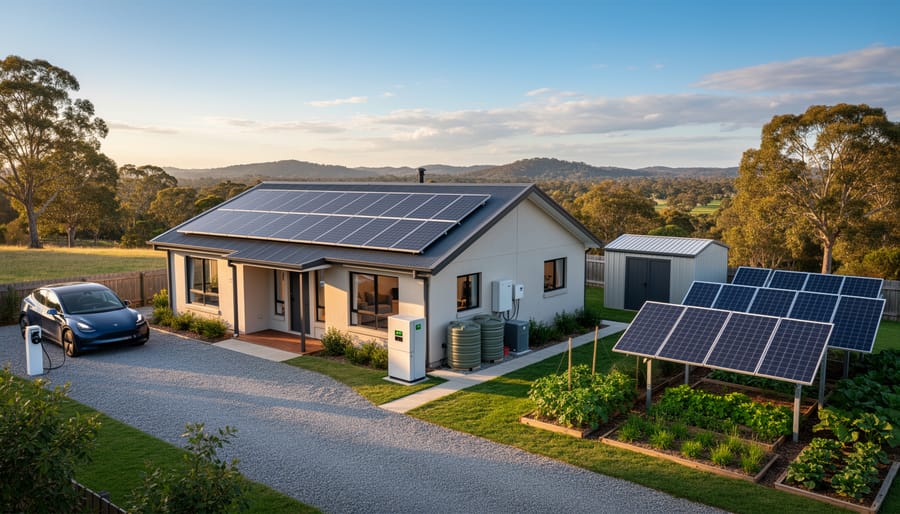
Essential Components of a Home Off-Grid Solar Power System
Solar Panels: Your Primary Power Source
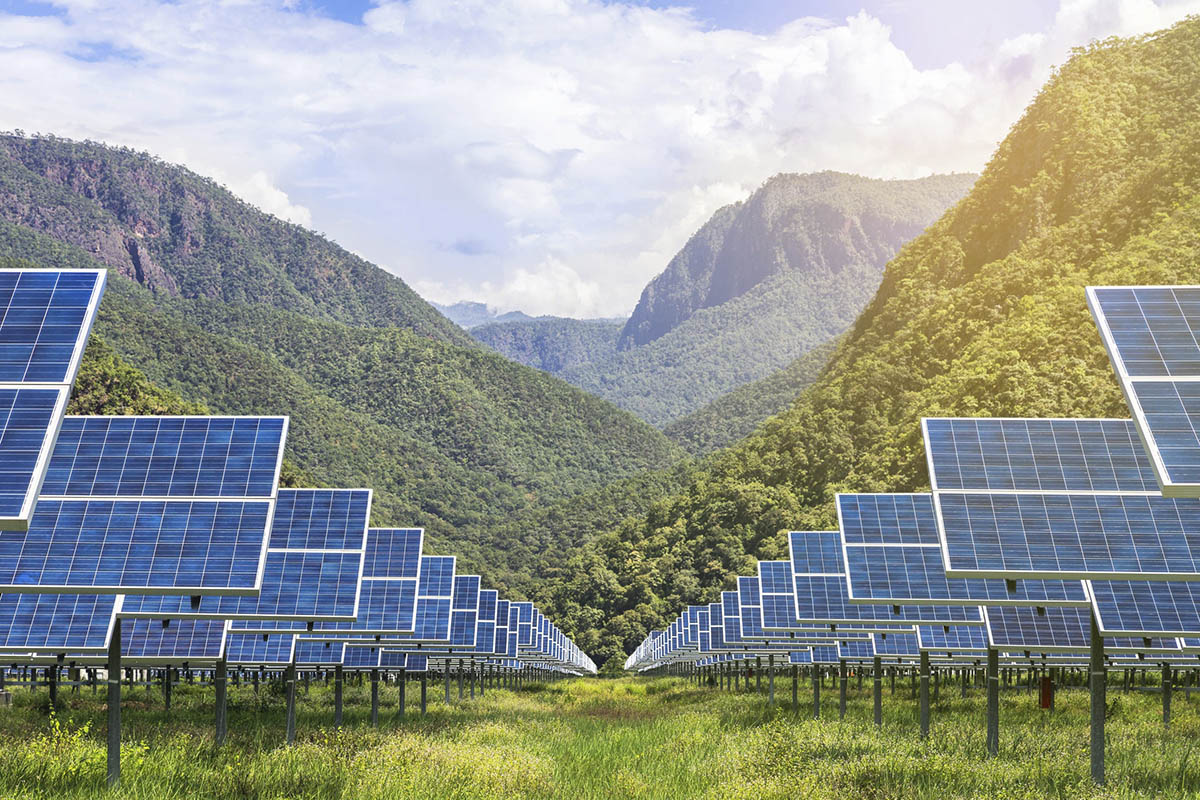
Solar panels convert sunlight into electricity, and they’re the heart of your off-grid power system. You’ll encounter three main types: monocrystalline panels offer the highest efficiency (18-22%) and perform best in limited space; polycrystalline panels cost less but need more roof area; and thin-film panels work well in partial shade but require significantly more space. For off-grid living, monocrystalline panels typically deliver the best long-term value.
Determining how many solar panels you need starts with your daily energy consumption. A typical American home uses 30 kWh per day, but off-gridders usually reduce this to 15-20 kWh through efficiency improvements. Figure on 6-8 panels (300-400 watts each) to generate 20 kWh daily in most regions, though your solar panel requirements vary with your location’s sun hours and seasonal weather patterns. Unlike grid-tied systems, you can’t lean on utility power during cloudy stretches, so off-grid arrays typically run 25-50% larger than equivalent grid-connected systems to ensure year-round reliability.
Battery Banks: Storing Energy for When the Sun Doesn’t Shine
Your battery bank determines whether you have power at 2 a.m. or sit in the dark. Most off-grid homes need 2-3 days of stored electricity to weather cloudy stretches without running a backup generator constantly.
Lithium batteries (LiFePO4) cost roughly double what lead-acid batteries do upfront, but they last 10-15 years versus 5-7 years, discharge deeper without damage (you can use 80-90% of capacity rather than just 50%), and require zero maintenance. Lead-acid batteries need regular watering, equalization charges, and careful monitoring, but they work reliably if you’re willing to do the work and accept replacing them more often.
Calculate your storage needs by tracking daily power consumption for a week. A household using 30 kWh per day needs 60-90 kWh of battery capacity for a comfortable two-day buffer. Round up, not down. Undersized battery banks force you to run generators frequently or ration power during bad weather.
Temperature matters considerably. Batteries lose capacity in cold weather, so many off-gridders install them in insulated spaces or underground. A battery bank living in a freezing garage performs 30-40% worse than one kept at room temperature.
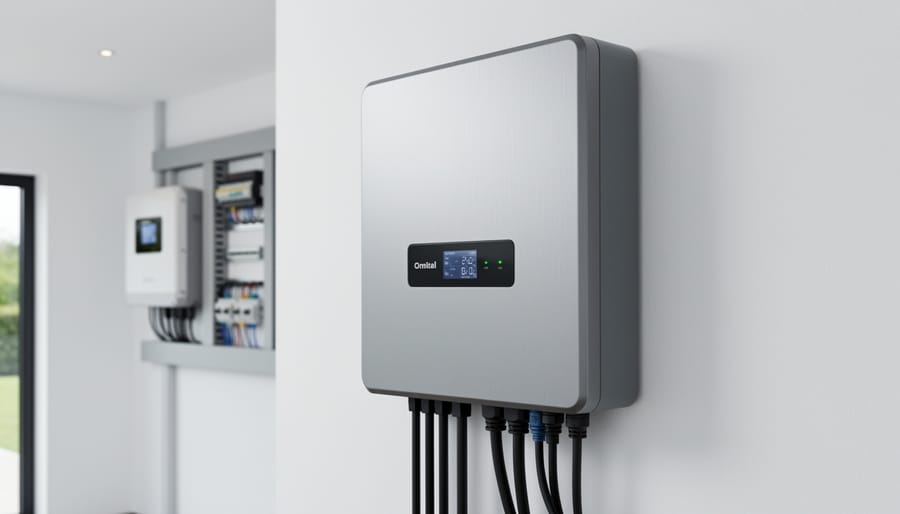
Charge Controllers and Inverters: Managing Your Power
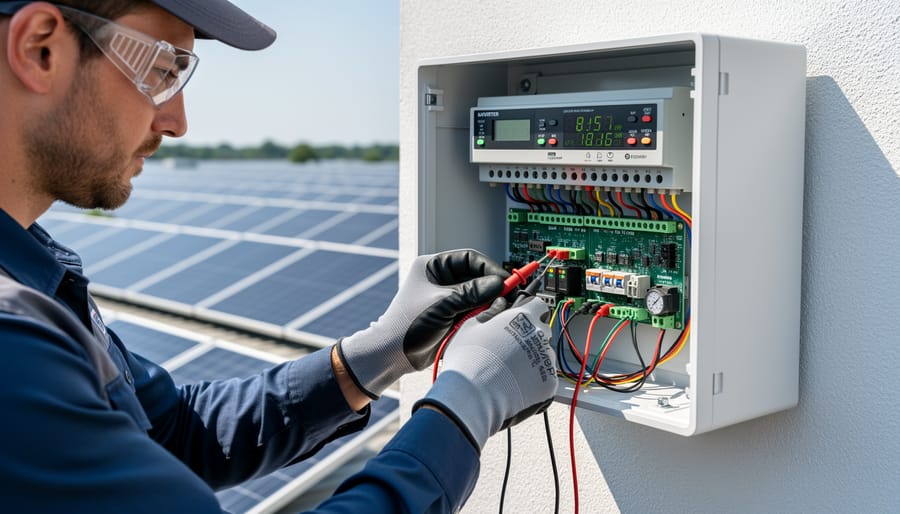
Your charge controller sits between your solar panels and battery bank, managing the charging process to prevent overcharging and extend battery life. Two main types exist: PWM (Pulse Width Modulation) controllers are cheaper and work fine for smaller systems, but MPPT (Maximum Power Point Tracking) controllers are 20-30% more efficient and worth the extra cost for most off-grid homes. An MPPT controller extracts maximum power from your panels even when conditions aren’t perfect, which matters when every watt counts for energy independence.
Your inverter converts the DC power stored in your batteries into the AC power your home appliances need. Pure sine wave inverters are essential for off-grid systems, modified sine wave units cost less but can damage sensitive electronics and motors. Size your inverter to handle your highest anticipated power draw plus a 25% safety margin. A 3,000-watt inverter handles most household loads, while larger homes might need 5,000 watts or more.
Choose quality components here. Cheap inverters fail when you need them most, and replacing them in an off-grid system means going without power until repairs are done.
Backup Generator: Your Insurance Policy
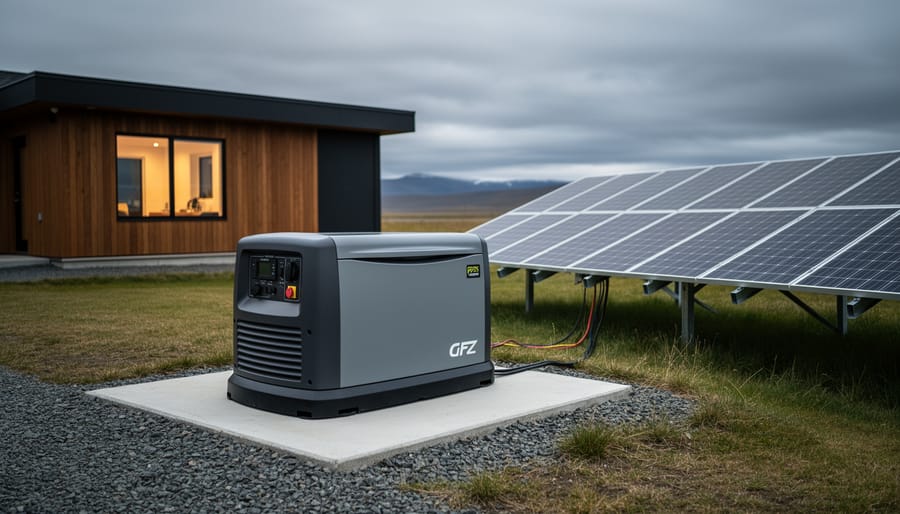
Even the most carefully sized off-grid solar power system faces an unavoidable reality: sometimes the sun just doesn’t cooperate. Three days of heavy clouds, a week of winter storms, or unexpected equipment failure can drain your battery bank faster than anticipated. That’s where a backup generator becomes essential insurance for your home’s energy security.
Most experienced off-gridders consider a generator non-negotiable, not a luxury. You’ll typically want a propane or diesel unit sized to run critical loads and recharge batteries when solar production falls short. A 5-7 kW generator handles most household needs while providing meaningful battery charging capacity. Calculate your baseline consumption during low-sun periods, then select a generator that can cover those loads plus deliver 20-40 amps of charging current to your battery bank.
Don’t think of your generator as a daily workhorse. In well-designed off-grid home solar power systems, it might run only 10-30 hours per year, serving as backup during extended weather events or maintenance periods. Many off-grid families report going months without starting theirs during good weather seasons. The key is having that capability when you need it, preventing the anxiety of watching battery levels drop with no sun in the forecast and no way to recover.
Sizing Your Off-Grid Solar System for Your Home’s Needs
Getting the size right is the difference between a system that works and one that leaves you in the dark. Unlike grid-tied setups with unlimited backup from utility power, your off-grid home solar power system needs to meet every watt of demand on its own.
Start by tracking your actual energy use. Most households underestimate consumption. Check your electric bills from the past year (if you’re still connected) or list every appliance, device, and light you plan to power. Don’t forget seasonal loads like space heaters in winter or fans in summer.
- List all appliances and devices with their wattage (found on labels or manuals)
- Estimate daily hours of use for each item
- Multiply wattage by hours to get watt-hours per day for each device
- Add everything together for your total daily consumption in watt-hours
- Convert to kilowatt-hours by dividing by 1,000
- Add 25-40% buffer for system losses, inefficiencies, and unexpected needs
A typical off-grid household uses 5-15 kWh daily, though this varies wildly based on climate, home size, and habits. A refrigerator might draw 1.5 kWh per day, LED lighting another 0.5 kWh, and a laptop 0.3 kWh. Those numbers add up fast.
Once you know your daily consumption, our panel sizing guide helps you calculate your panel count based on your location’s sun hours. But here’s the catch: you need enough panels to fill your batteries and run your home simultaneously during peak sunlight.
Battery capacity matters just as much. Most off-gridders size their battery banks for three to five days of autonomy, meaning you can survive cloudy stretches without generator backup. If you use 10 kWh daily, you’ll need 30-50 kWh of usable battery storage.
Seasonal variations complicate everything. Winter brings shorter days and lower sun angles. Your system must handle December’s production, not July’s. In northern climates, you might need twice the panels compared to summer requirements just to keep batteries charged through grey weeks.
Lifestyle choices directly impact system size. Energy-efficient appliances, propane for cooking and water heating, and LED lighting throughout reduce your solar array needs dramatically. Some families cut their requirements in half by switching to gas refrigerators and wood heat.
Real Costs and Financial Planning for Off-Grid Solar in 2026
# Real Costs and Financial Planning for Off-Grid Solar in 2026
Let’s talk numbers. A complete home solar power system off grid typically costs between $30,000 and $60,000 for a typical household, depending on your energy needs and component choices. That’s significantly more than a grid-tied system, primarily because you’re paying for substantial battery storage and backup equipment.
Here’s how costs break down for a mid-sized system: expect $12,000-$18,000 for solar panels, $15,000-$25,000 for a quality lithium battery bank, $3,000-$5,000 for inverters and charge controllers, and another $2,000-$5,000 for a backup generator and miscellaneous components. Installation adds 15-25% if you hire professionals, though many off-gridders reduce costs by handling portions themselves.
Ongoing expenses are modest but real. Budget $500-$1,000 annually for maintenance, which includes occasional battery replacements every 10-15 years (lithium) or 5-8 years (lead-acid), inverter service, and generator upkeep. These costs pale next to typical utility bills, but they exist.
The financial picture shifts dramatically when you eliminate monthly electric bills. If you currently pay $150-$250 monthly for power, you’re saving $1,800-$3,000 yearly. However, traditional payback calculations don’t quite work for off-grid systems because you’re not just saving money, you’re buying independence from utility infrastructure.
Financing options in 2026 include solar loans, home equity lines of credit, and specialized green energy financing programs. Some rural development grants help offset costs in certain areas. Cash purchases avoid interest but require significant upfront capital.
Realistically, if you’re pursuing off-grid solar purely for financial return, the 15-20 year breakeven timeline may disappoint you. But if you’re in a remote location where grid connection costs $40,000 or more, or you value energy security and environmental benefits alongside financial considerations, the math becomes compelling. Many off-gridders report that freedom from power outages and rate increases justifies the investment beyond simple dollar calculations.
Living Off-Grid: Daily Realities and Energy Management
Living off-grid with solar power fundamentally changes your relationship with electricity. You become acutely aware of every kilowatt-hour, watching your battery levels like a farmer watches the weather. Most off-gridders check their system monitor first thing each morning, before coffee, to see how the batteries fared overnight and what the day’s solar forecast looks like.
Energy management becomes intuitive after a few months. You learn to run heavy loads during peak sun hours when panels are actively charging your batteries. That means doing laundry at 1 PM instead of 8 PM, running the well pump during daylight, and timing dishwasher cycles for sunny afternoons. On overcast days, you postpone power-hungry tasks or accept that the backup generator might kick in.
Weather awareness takes on new meaning. A three-day cloudy stretch in winter requires different strategies than summer’s long, sunny days. You develop a feel for how much reserve capacity you have and when to conserve. Some off-gridders install small weather stations to track incoming cloud systems, while others simply learn their local patterns through observation.
Successful off-grid households adopt lifestyle changes that reduce energy demand without feeling restrictive:
- Switching to LED bulbs and energy-efficient appliances cuts consumption by 40-60% compared to standard models
- Line-drying clothes instead of using electric dryers saves substantial battery power for other needs
- Using propane for cooking and water heating eliminates major electrical loads
- Installing a wood stove for heating drastically reduces winter electrical demands
- Choosing DC-powered devices when possible avoids inverter losses
These adaptations become second nature. Most off-gridders report feeling more connected to natural rhythms and more satisfied with their energy usage, not deprived. The system teaches mindfulness, you notice phantom loads, reconsider automatic habits, and make deliberate choices about power use. Your battery bank becomes a tangible resource you manage actively rather than an invisible utility you ignore.
Success Story: The Mountain Community That Cut the Cord
When the fifteen households of Pine Ridge Valley first gathered to discuss cutting ties with the local utility in 2023, skepticism ran high. Three years later, their shared off-grid solar installation powers every home, barn, and workshop in this tight-knit Colorado community.
The group started by pooling resources to hire an energy consultant who helped them calculate collective needs. Each family tracked power usage for three months, revealing surprising patterns. The Johnsons discovered their old chest freezer consumed nearly 40% of their electricity. The Martinez family found their well pump’s startup surge required more capacity than they’d assumed.
Together, they determined the right number of panels for their elevation and winter sun angles, ultimately installing 180 panels across multiple arrays positioned on south-facing hillsides. They negotiated bulk pricing on lithium batteries, cutting costs by 30% compared to individual purchases.
The first winter tested their system hard. January brought eleven consecutive cloudy days, draining batteries to 40% capacity before their shared propane generator kicked in. Rather than panic, the community adapted. They created a simple text alert system to coordinate high-draw activities like laundry during peak sun hours.
Sarah Chen, who coordinated the project, emphasizes their biggest lesson: “We learned to think as a micro-grid, not isolated homes. When the Hendersons needed extra power for their daughter’s medical equipment, three families temporarily reduced usage. That’s the community resilience we never had with the utility company.”
Getting Started: First Steps Toward Off-Grid Solar Independence
Taking the leap toward your own home solar power system off grid starts with gathering information and building your support network. Your first step is connecting with people who’ve already made the transition. Join online forums like the Off-Grid Living subreddit, attend regional renewable energy fairs, or seek out local sustainability groups where experienced off-gridders freely share their hard-won knowledge. These connections prove invaluable when you’re choosing components or troubleshooting issues that don’t appear in manuals.
Next, assess whether you’ll hire professionals or tackle installation yourself. DIY can cut costs by 30-40%, but requires electrical knowledge, comfort working on roofs, and significant time investment. If you go the professional route, seek installers with specific off-grid experience, grid-tied solar installers often lack the battery integration and system-sizing expertise that off-grid demands. Ask for references from actual off-grid clients and visit completed installations if possible.
Before ordering equipment, research your local permitting landscape. Requirements vary wildly by county and can include electrical permits, building permits for ground-mounted arrays, and even zoning approval if you’re in restricted areas. Some rural counties have minimal requirements, while others treat off-grid systems like major construction projects.
Here are essential first steps for launching your off-grid solar journey:
- Calculate your daily energy consumption by tracking usage for at least one month
- Get three quotes from qualified off-grid installers in your region for comparison
- Contact your county building department to understand permit requirements and timelines
- Join at least one online community of off-grid homeowners for ongoing support
- Visit functioning off-grid homes in person to see real systems and ask candid questions
- Create a realistic budget that includes 15-20% contingency for unexpected costs
Start small if needed. Some families begin with a basic system powering essential circuits, then expand capacity as budget allows. This phased approach lets you learn the rhythms of solar living before committing to a complete home power off grid system. The knowledge you gain from that first kilowatt-hour of independence is worth more than any installation manual.
Taking the leap to an off-grid home solar power system isn’t just about cutting ties with your utility company. It’s about building genuine energy independence, creating resilience in your community, and taking meaningful action for environmental sustainability. Yes, the upfront investment is significant, and you’ll need to think differently about how you use power. But thousands of households across the country are proving every day that off-grid solar works, and works well.
The technology has matured. Batteries last longer. Solar panels are more efficient than ever. The knowledge base has grown enormously, with experienced off-gridders eager to share what they’ve learned. Whether you start small with a cabin system or go all-in with a full household setup, you’re joining a movement of people who’ve decided that energy freedom matters.
Talk to your neighbors. Connect with local solar professionals. Visit someone already living off-grid if you can. Your path to solar independence starts with a single conversation, a single calculation, a single decision to explore what’s possible. The sun rises every morning, free and abundant. Why not harness it?