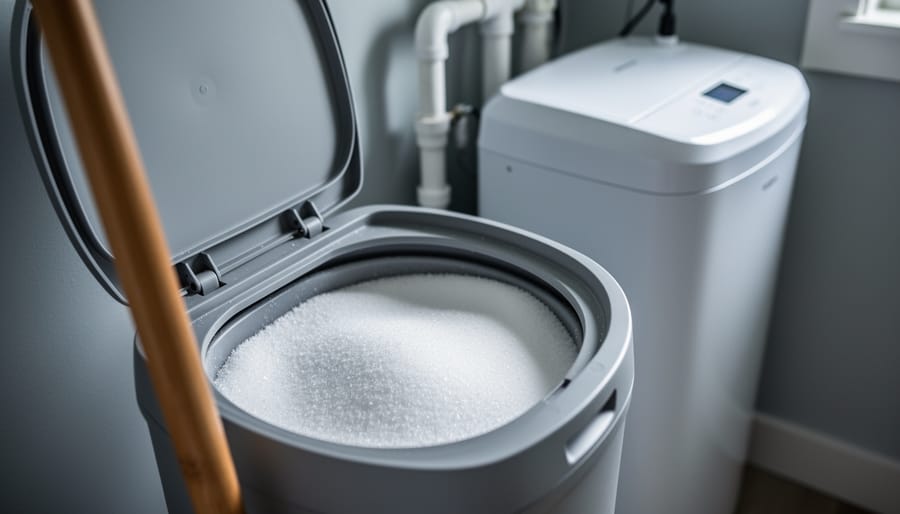
Hard water creeping back into your shower, a salt tank that never seems to empty, a blank display: nine times out of ten, the culprit is a salt bridge or a stalled regeneration cycle. A salt bridge is a hard crust that forms in the brine tank and leaves an empty gap underneath, so the salt never dissolves into the water that recharges your softener’s resin beads.
Here’s the quickest check. Lift the brine tank lid and press a broom handle straight down into the salt. If it hits a hard crust and sinks into open space below, you’ve found it. Break the crust apart, scoop out any clumps, and run a manual regeneration. Many households get soft water back within a day.
If the salt looks fine, don’t worry. This guide walks you through a symptom-by-symptom approach to water softener troubleshooting from low pressure to display glitches, with plain-language explanations and step-by-step repairs you can do with basic tools.
A well-tuned softener also saves salt, water, and energy, which is good news for your wallet and your neighborhood’s water supply. Safety note: if you see leaking near electrical connections or can’t shut off the water supply, stop and call a licensed plumber.
Start Here: Matching Your Symptom to the Right Fix (Symptom Triage)
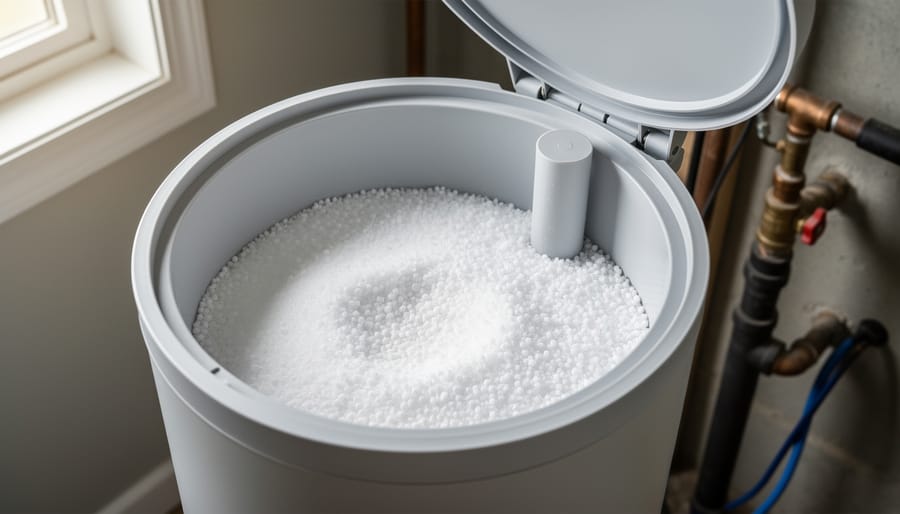
Quick Checks Before You Touch Anything
Before you pick up a single tool, spend two minutes on the basics. You’d be surprised how often one of these is the whole story, and checking them costs nothing.
- Confirm the plug is firmly in the outlet and the outlet actually has power (a lamp makes a quick tester).
- Make sure the bypass valve is set to “service,” not “bypass,” so water is actually flowing through the softener.
- Lift the brine tank lid and check that the salt sits well above the water line.
- Check that the main water supply valve to the softener is fully open.
- Glance at the display for a blinking light, a blank screen or an error message, and jot down what you see.
One more step is worth doing: confirm that hard water is truly the problem. A cheap test strip from a hardware store takes about a minute. Test a cold tap and read the result against the color chart. If your water tests soft, the softener may be working fine, and the issue could be something else, like a plumbing fixture or a water heater.
Plenty of homeowners solve their problem right here, so don’t skip these steps.
Likely Causes Behind Common GE Water Softener Problems
Salt Bridges and Mushing: The Most Common Culprit
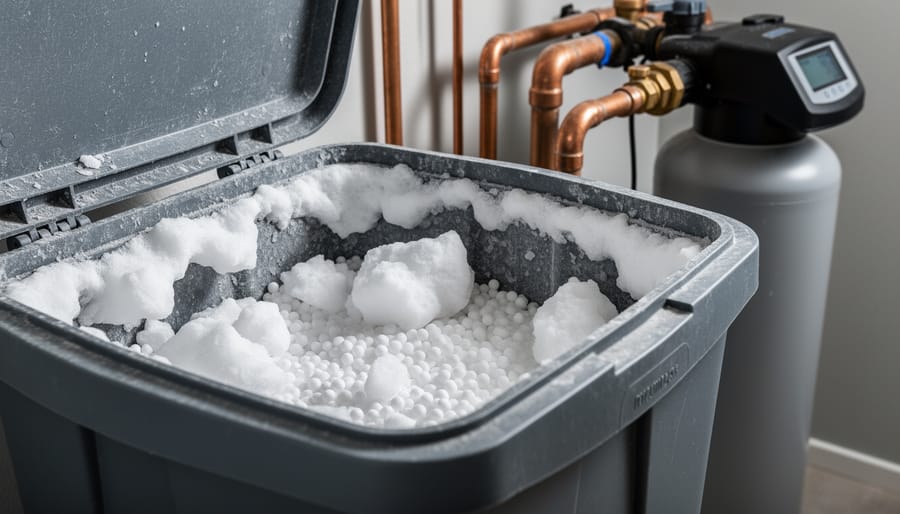
A salt bridge is a hard crust that forms across the top of the salt in your brine tank, leaving an empty gap underneath. Mushing is the cousin of that problem, where salt turns into a sludgy layer at the bottom. In both cases, water can’t dissolve enough salt to make brine, so your softener “runs” its cycles but the resin never gets refreshed. That’s why hard water creeps back even though the tank looks full.
Humidity, overfilling and salt type all feed the problem. Damp air makes salt cake together, filling past the recommended line leaves salt sitting wet, and cheaper rock or fine-grain salts tend to clump. Here’s how it compares with other symptoms, and you can read more about the causes and fixes behind them:
| What You Notice | Most Likely Cause | Difficulty |
|---|---|---|
| Hard water returning | Salt bridge or mushing | Easy |
| No salt use | Salt bridge | Easy |
| Won’t regenerate | Settings or power issue | Easy to moderate |
If the first two rows sound familiar, a salt bridge is your likely suspect.
Settings, Power and Hardness Mismatches
A softener can work perfectly for months, then quietly start letting hard water through because its settings no longer match your home. Power outages are a common trigger. Many control heads lose the clock or reset the hardness number, so regeneration starts at the wrong hour or runs on the wrong schedule. The same thing can happen after a move, since the last owner’s settings may not fit your water.
Water itself changes too. A new well, a heavier laundry routine or extra people in the house can all push the unit past what it was set to handle. Retest your water, then compare the result to these terms:
- Hardness setting (grains per gallon)
- The number you enter so the softener knows how many hardness minerals to remove. Set it too low and hard water slips through; too high and you waste salt and water.
- Regeneration
- The cleaning cycle where salty brine rinses the resin beads and sends trapped minerals down the drain.
- Resin beads
- Tiny beads inside the tank that grab hardness minerals as water flows past.
- Bypass valve
- A valve that routes water around the softener, handy for repairs but a common reason water stays hard if left open.
Resetting the clock and hardness level takes just a few minutes, and your manual shows the exact button sequence for your model.
Step-by-Step Fixes You Can Do at Home
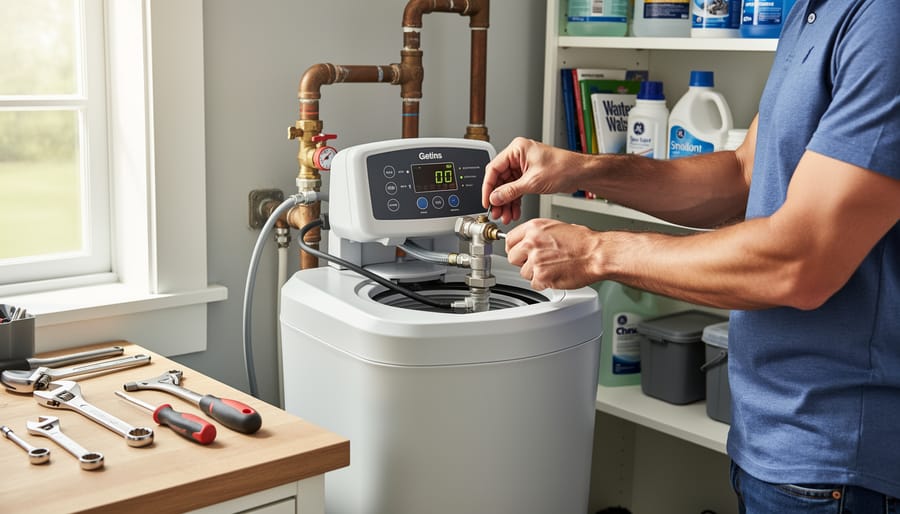
How to Break Up a Salt Bridge and Restart Regeneration
A salt bridge is easy to fix once you know what you’re looking at. The softener keeps cycling, but the brine never forms, so your water stays hard. Here’s the sequence that gets most GE units back on track.
First, unplug the unit or switch it to bypass so no cycle starts while your hands are near the tank. Then lift the brine tank lid and look inside. Shine a flashlight in. If the salt looks heaped up but there’s a gap or empty space underneath, you’ve got a bridge. If the bottom is a gray, soupy sludge, that’s mushing.
- Put the unit in bypass and unplug it, then remove the brine tank lid.
- Press a broom handle gently straight down into the salt. If it hits a hard crust, tap it to break it up. Keep clear of the tank walls and the brine well and fittings in the middle, since cracks and bent parts cause new problems.
- Scoop out any wet, mushy, or clumped salt with a small bucket and discard it. Don’t pour it down a drain in large amounts.
- Pour in fresh softener salt, filling to about halfway or the manufacturer’s marked level, but never above the brine well top.
- Plug the unit back in, take it off bypass, and set the clock if it has reset.
- Start a manual regeneration using the regenerate button on your control head. Check your model’s manual for exactly how long to hold it.
Give the cycle time to finish. It can run well over an hour, and you may hear water moving and brine drawing. Once it’s done, wait a few hours and run a hardness test strip on a cold tap. If the reading drops to near zero, the fix worked. Sharing your hardness test results with a neighbor is a nice habit, too, since many households on the same water supply see similar problems.
Cleaning the Injector, Screen and Brine Tank
If your softener has plenty of salt but the water is still hard, and the brine tank barely seems to draw down, a clogged injector is a likely suspect. Small bits of salt dust and sediment can block the tiny passage that pulls brine from the tank. It’s worth trying this fix when salt use has dropped or your manual regeneration finishes with no change in the water.
Start by unplugging the unit and switching the bypass valve so water flows around the softener. Then relieve pressure by briefly opening a nearby faucet. The first thing to do is locate and clean the injector and screen which usually sit behind a cap on the control head. Check your model’s manual to see exactly where yours is.
1. Unscrew the cap and gently pull out the injector and the small screen beneath it.
2. Rinse both in warm water. A soft toothbrush or cotton swab clears stubborn grit from the tiny openings.
3. Never poke the injector with a pin or metal tool, since scratches can ruin its flow.
4. Reseat the screen and injector, making sure any O-rings are in place, then hand-tighten the cap.
While you’re in there, empty the brine tank. Scoop out the remaining salt, wipe away any sludge with a sponge, and rinse with a little warm water. Let it drain fully before refilling with fresh salt.
Finally, return the bypass valve to its normal position, plug the unit back in, and run a manual regeneration. Test your water afterward to confirm the softness is back. It’s a satisfying fix, and it keeps your system running efficiently.
Resetting Settings and Reading Error Codes
After a power outage, many GE softeners lose their clock and fall back on default settings. That means the unit may regenerate at the wrong time, or not at all. Start by resetting the time of day on the control display, following the button sequence in your manual. Then confirm the regeneration schedule, since some models keep it and others need it re-entered.
Next, check the hardness setting. Use a test strip or a kit from your local hardware store to measure your water, then enter that number into the control head. A setting that’s too low lets hardness slip through, while one that’s too high wastes salt and water on cycles you don’t need. If you’re on a well, retest once or twice a year, because mineral levels can shift.
If the display shows an error code, don’t guess at its meaning. Codes vary by model, so look in the owner’s manual or on the label inside the control cover for your model number. GE’s support site also lists manuals you can search by that number.
When It’s Time to Call a Pro or Consider Replacement
Most softener troubles are simple, and you’ve likely worked through the big ones by now. Still, every DIY effort has a ceiling, and knowing where yours sits saves you time, salt and frustration.
Consider reaching out for help if you notice any of these signs:
– Hard water persists even after you’ve cleared a salt bridge, cleaned the injector and screen, and confirmed your settings.
– You see water leaking around the valve or control head.
– The softener runs through its cycles and uses salt, yet the water never softens. That often means the resin bed (the tiny beads that trap hardness minerals) has worn out and can no longer hold its capacity.
– The unit is quite old and the problems keep stacking up.
None of this means you did anything wrong. Well-maintained softeners often serve a household for many years, and eventually parts simply wear down.
Your first call can be GE support, who can help identify your exact model and point you toward the right parts or service. You can also bring in a local water treatment pro. Choosing a small, locally owned business keeps your repair dollars circulating in your community, and local techs often know the quirks of your area’s water.
Repair or replacement, you’ll be making the choice with a clear picture of what’s happening.
Keeping Your Softener Healthy: Prevention and Efficient Water Use
A Neighborhood Success Story: Sharing Know-How Across the Block
Picture a quiet street where a few neighbors realize they’re all fighting the same stubborn problem: chalky glassware, crusty showerheads, and softeners that never quite seem right. Instead of each household puzzling it out alone, one person suggests a Saturday morning get-together. Everyone brings a water test kit, a broom handle, a bucket, and whatever tools they own.
By lunchtime, the group has tested every tap, compared hardness settings, and cleared a salt bridge or two. One neighbor shows how to check the brine tank. Another passes around a spare wrench. People leave with working softeners, a few new friendships, and money saved on service calls. It’s a small gathering, but it reflects the heart of sustainable development: practical, shared solutions that use fewer resources and make everyone’s home a little more resilient.
You can spark the same thing where you live:
– Start a water-quality swap. Trade test results and hardness settings so neighbors can spot problems early.
– Host a tool-lending shelf. One shared box of wrenches, brushes, and a spare brine bucket saves everyone from buying their own.
– Share maintenance reminders. A quick monthly nudge in your local group helps people remember to check their salt.
– Support local water professionals. When a job needs an expert, hiring a nearby business keeps your community’s skills and economy strong.
GE Water Softener Troubleshooting FAQs
Most GE softener questions have simple answers, and the ones below come up again and again. If your situation doesn’t match, check your model’s manual or GE support.
Why is my GE softener using no salt?
Usually that points to a salt bridge, where a hard crust stops brine from forming, or a clogged injector that can’t draw it. Break up any crust, clear mushy salt, and run a manual regeneration to see if salt use returns.
Why does my water still feel hard after regeneration?
Check the basics first: the hardness setting, whether the bypass valve is open, and whether the brine tank actually has dry salt. If those look right, a fouled resin bed or blocked injector may be the cause.
Can I use any salt in my softener?
Not quite. Choose a salt type your model’s manual recommends, and avoid overfilling, since too much salt can contribute to bridging and mushing.
How long should a softener last?
A well-maintained unit often serves a household for many years. Regular salt checks, an annual cleaning of the brine tank, and accurate settings go a long way toward getting there.
Wondering how often to add salt? A monthly look at the brine tank is a good habit, and topping it up before it runs low keeps things simple. A salty taste is another common worry. It isn’t normal, so run a manual regeneration, then recheck your settings and the brine tank for trouble.
If you’ve worked through a fix and found something that worked, share it with a neighbor. Small bits of know-how like this keep more softeners running efficiently across the whole community.
Most GE water softener troubleshooting follows the same simple path. Start with the symptom, run the quick checks, and look at the likely causes, from a salt bridge to a clogged injector to a settings mix-up. Then work through the fixes one at a time, from simplest to most involved, and you’ll solve the majority of problems without a service call.
Once it’s running well again, a few small habits keep it that way: a monthly salt check, an occasional brine tank cleaning, and a hardness setting that matches your water. Those habits protect your pipes and appliances, and they cut down on wasted salt and water, which is good for your household and your local watershed.
If you found a fix that worked, tell a neighbor or share it in your community group. Your tip could save someone else a frustrating weekend. When you’re ready for more, browse the other Water Softener Solutions on the site.